AQA GCSE English Literature · Paper 1 · Section B: the 19th-century novel

A Christmas Carol

Your guide to Dickens's ghost story: what happens in each stave, the quotations to learn, the characters and themes, and how to write about them in the exam.

Made for Eesa

How to use this guide

1. Watch it like a series

The novel has five staves (chapters), like five episodes. The first four build towards Scrooge's choice; the last shows what he does with it. Start with the story.

2. Learn it in layers

First the one-sentence summary and "What happens". Then the key extracts and the quotation bank. Then characters, themes and context.

3. Test yourself

Tap the questions at the end of each stave, then try the four quiz rounds. Answers stay hidden until you tap.

1The exam

Paper 1, Section B. AQA prints an extract from the novel (about one page); you write about it and about the rest of the novel from memory, in whichever order helps your argument. The exam is closed book.

1 + 1the extract and the whole novel

The question has two bullets: how Dickens presents the idea in the extract, and in the novel as a whole. Cover both.

30marks

12 for your response and quotations (AO1), 12 for language, form and structure (AO2), 6 for context (AO3). There are no spelling and grammar marks in this section.

50minutes

Paper 1 lasts 1 hour 45 minutes and has 64 marks: 34 for Section A (including 4 for spelling and grammar) and 30 for this question. The examiners say to spend equal time on both sections. That is about 50 minutes for this one.

Extract and whole novel. Write about the extract and about other moments in the novel. AQA says an answer that misses either part can be capped at the top of Level 2: 10 marks out of 30.

Every A Christmas Carol question, specimen to June 2025

Every question has the same shape: ‘Starting with this extract, explore how Dickens presents [an idea] in A Christmas Carol’, then the same two bullets. Here is every one AQA set from the specimen to June 2025, word for word.

ExamExtractThe question, word for word
SpecimenStave One
In this extract Scrooge is being introduced to the reader.
Starting with this extract, how does Dickens present Scrooge as an outsider to society?
  • how Dickens presents Scrooge in this extract
  • how Dickens presents Scrooge as an outsider to society in the novel as a whole.
June 2017Stave Three
In this extract, the Ghost of Christmas Present shows Scrooge the Cratchit family’s Christmas celebrations.
Starting with this extract, explore how Dickens uses the Cratchit family to show the struggles of the poor.
  • how Dickens presents the Cratchit family in this extract
  • how Dickens uses the Cratchit family to show the struggles of the poor in the novel as a whole.
June 2018Stave Four
In this extract, Scrooge meets the Ghost of Christmas Yet To Come.
Starting with this extract, explore how Dickens presents Scrooge’s fears in A Christmas Carol.
  • how Dickens presents what Scrooge is frightened of in this extract
  • how Dickens presents Scrooge’s fears in the novel as a whole.
June 2019Stave One
In this extract Scrooge is visited by Marley’s Ghost.
Starting with this extract, explore how Dickens uses the ghosts to help Scrooge change his attitudes and behaviour.
  • how Dickens uses Marley’s Ghost in this extract
  • how Dickens uses the ghosts to help Scrooge change his attitudes and behaviour in the novel as a whole.
November 2020Stave Three
In this extract, the Ghost of Christmas Present is about to leave Scrooge.
Starting with this extract, explore how Dickens presents the suffering of the poor in A Christmas Carol.
  • how Dickens presents the suffering of the poor in this extract
  • how Dickens presents the suffering of the poor in the novel as a whole.
November 2021Stave Two
In this extract, the Ghost of Christmas Past shows Scrooge the Christmas party he attended at Mr Fezziwig’s warehouse when he was a young man.
Starting with this extract, explore how Dickens presents ideas about joy and happiness in A Christmas Carol.
  • how Dickens presents joy and happiness in this extract
  • how Dickens presents ideas about joy and happiness in the novel as a whole.
Sample for 2022Stave Four
In this extract, Scrooge meets the Ghost of Christmas Yet To Come.
Starting with this extract, explore how Dickens presents Scrooge’s fears in A Christmas Carol.
  • how Dickens presents what Scrooge is frightened of in this extract
  • how Dickens presents Scrooge’s fears in the novel as a whole.
June 2022Stave Two
In this extract, the Ghost of Christmas Past takes Scrooge back to his school.
Starting with this extract, explore how Dickens presents the effects of loneliness and isolation in A Christmas Carol.
  • how Dickens presents the effects of loneliness and isolation in this extract
  • how Dickens presents the effects of loneliness and isolation in the novel as a whole.
June 2023Stave Two
In this extract, the Ghost of Christmas Past shows Scrooge his last meeting with Belle.
Starting with this extract, explore how Dickens presents the effects of greed in A Christmas Carol.
  • how Dickens presents the effects of greed in this extract
  • how Dickens presents the effects of greed in the novel as a whole.
June 2024Stave Four
In this extract, the Ghost of Christmas Yet to Come shows Scrooge the scene at a deathbed.
Starting with this extract, explore how Dickens presents the lessons Scrooge learns about life in A Christmas Carol.
  • how Dickens presents Scrooge in this extract
  • how Dickens presents the lessons Scrooge learns about life in the novel as a whole.
June 2025Stave Three
In this extract, the Ghost of Christmas Present shows Scrooge the Cratchit family at Christmas.
Starting with this extract, explore how Dickens presents the importance of kindness in A Christmas Carol.
  • how Dickens presents kindness in this extract
  • how Dickens presents the importance of kindness in the novel as a whole.

AQA’s papers call the staves ‘chapters’. In November 2021 and June 2022 the novel had its own 50-minute paper (8702/1N) and was Question 02, and the 2022 sample paper used the same 8702/1N format; in every other series it is Question 08 on Paper 1. The November 2020 exam used the June 2020 paper, which was not sat that summer. The grey rows are practice papers, not real exams. Tap a stave name to read about that stave; the extracts AQA printed in 2020, 2023, 2024 and 2025 are printed in full in the stave sections.

A pattern, not a prediction. In the nine real exams from 2017 to 2025, AQA printed extracts from Stave Two three times, Stave Three three times, Stave Four twice and Stave One once. Stave Five was not printed in any of them, and Fred, family and Christmas itself were not the named focus. Your mock asked how Christmas is presented, and Christmas runs through almost every answer anyway: the 2017 and 2025 extracts are both the Cratchits’ Christmas. That is a pattern, not a prediction: any stave and any idea can come up.

What the examiners say

2The story, stave by stave

Five staves, five episodes. Tap a picture to jump to that stave. Each stave has the same layout, so you always know where to look.

1

Stave One

Marley’s Ghost

On a freezing Christmas Eve we meet Scrooge at his worst: mean, cold and alone. Then his dead partner, Marley, returns as a ghost in chains to warn him to change.

Printed in a real exam. June 2019: how the ghosts help Scrooge change.
Used in a practice paper. Specimen: Scrooge as an outsider to society.
WhenChristmas Eve, from afternoon to night.
WhereScrooge’s counting-house (office) in the City of London, then his dark rooms.
MoodCold, gloomy and spooky, but often funny.

What happens

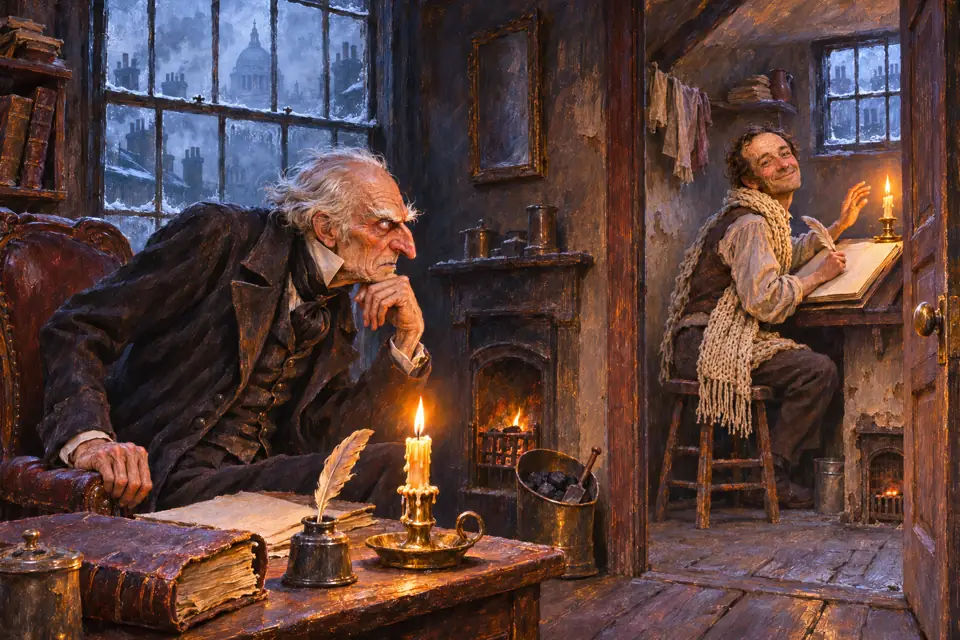
  1. Marley has been dead for seven years. On Christmas Eve Scrooge is at work in his cold counting-house. His clerk, Bob Cratchit, copies letters by a fire so small that it looked like one coal.

    Scrooge at his desk by a small fire; through the door, Bob Cratchit in his white comforter copies letters by a fire of one coal.
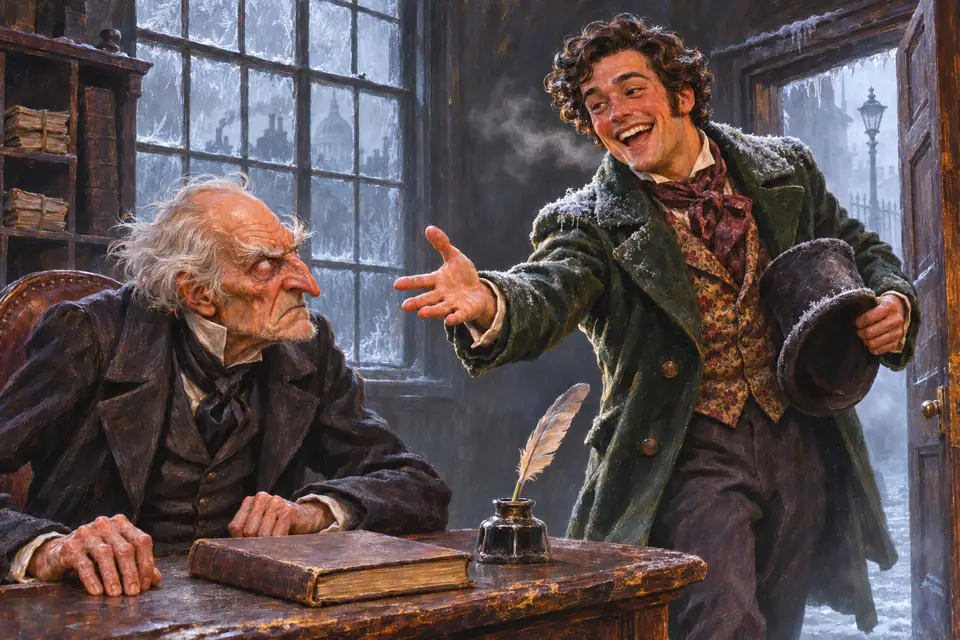
  2. Scrooge’s cheerful nephew, Fred, calls in to say A merry Christmas, uncle!. Scrooge answers Humbug!. Fred invites him to Christmas dinner, and Scrooge refuses. Fred stays good-tempered.

    Fred, glowing from the cold, greets his scowling uncle in the counting-house.
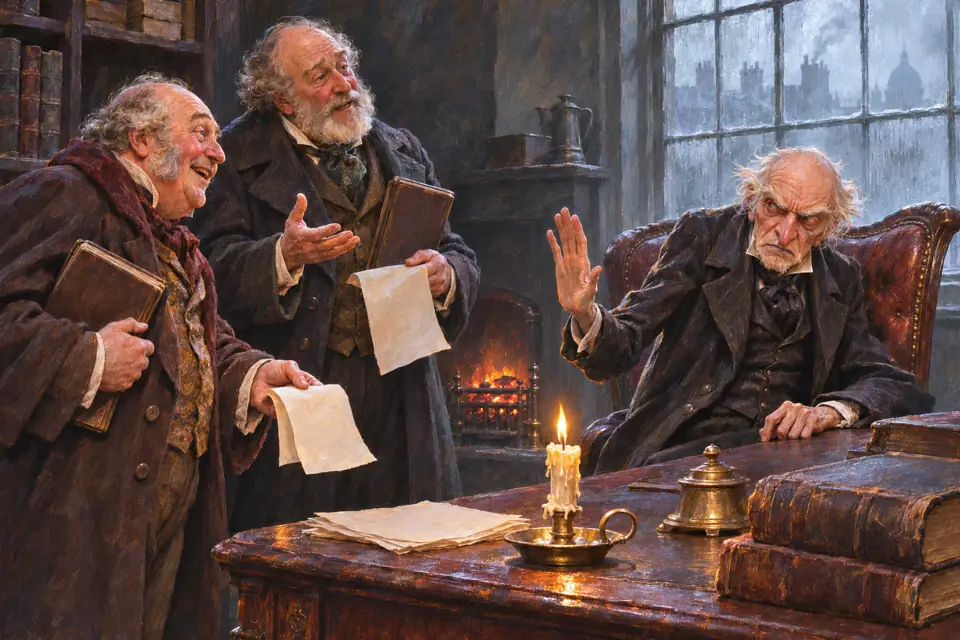
  3. Two gentlemen ask for money to help the poor at Christmas. Scrooge asks Are there no prisons? and says that if the poor would rather die, they had better do it, and decrease the surplus population. He gives nothing, then scares off a boy singing a carol at his keyhole.

    Two portly gentlemen with blank papers ask Scrooge for money; he waves them away.
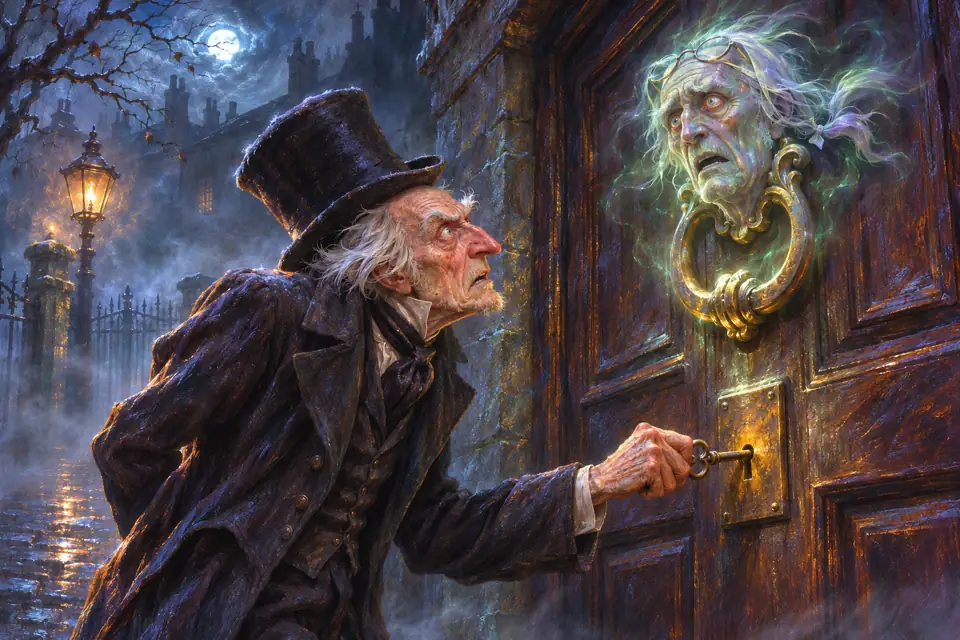
  4. Scrooge lets Bob have Christmas Day off, but calls it a poor excuse for picking a man’s pocket every twenty-fifth of December! At home, the knocker on his front door turns into Marley’s face.

    At night, Scrooge freezes at his front door: the brass knocker has become Marley's glowing ghostly face, spectacles turned up on its forehead.
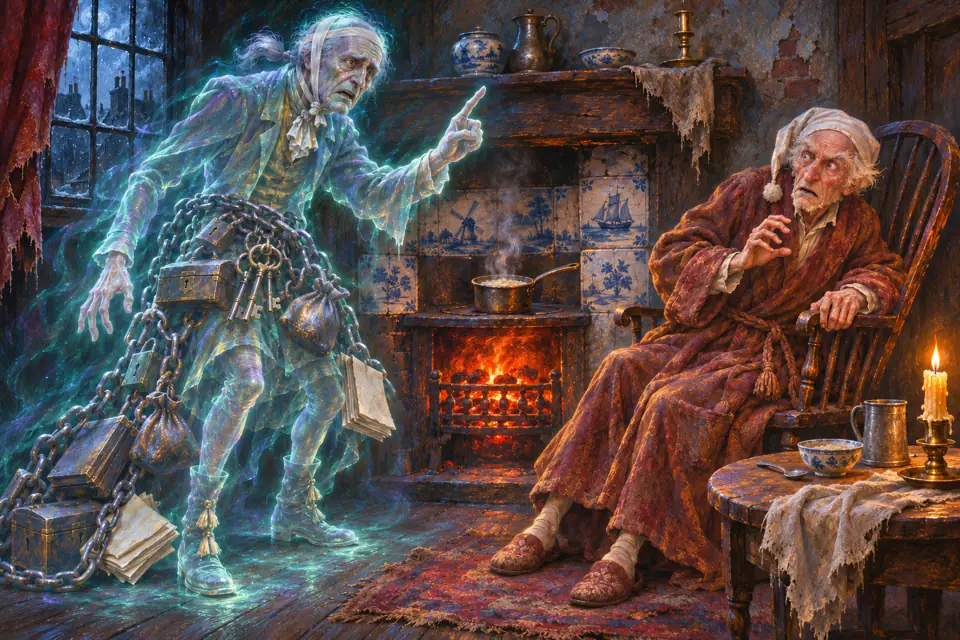
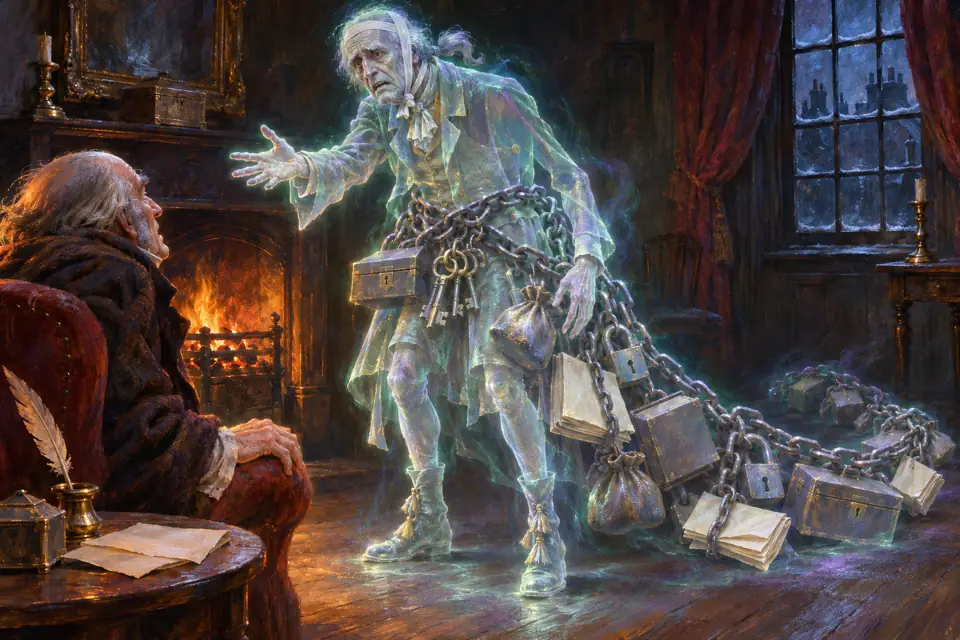
  5. Marley’s Ghost appears, wrapped in a chain of cash-boxes, keys, padlocks, ledgers, deeds, and heavy purses. He says he made the chain himself in life, and warns Scrooge that three Spirits will visit him.

    Scrooge in nightcap and dressing-gown recoils as Marley's see-through ghost, wrapped in a chain of cash-boxes and padlocks, raises a hand in warning.

Key extracts

Read the extract: Scrooge, the covetous, old sinner (348 words)

The narrator’s portrait of Scrooge before the story begins. Notice the lists, the cold imagery and the way everyone, even the dogs, avoids him. AQA’s specimen paper printed the last three paragraphs.

Oh! But he was a tight-fisted hand at the grind-stone, Scrooge! a squeezing, wrenching, grasping, scraping, clutching, covetous, old sinner! Hard and sharp as flint, from which no steel had ever struck out generous fire; secret, and self-contained, and solitary as an oyster. The cold within him froze his old features, nipped his pointed nose, shrivelled his cheek, stiffened his gait; made his eyes red, his thin lips blue; and spoke out shrewdly in his grating voice. A frosty rime was on his head, and on his eyebrows, and his wiry chin. He carried his own low temperature always about with him; he iced his office in the dog-days; and didn’t thaw it one degree at Christmas.

External heat and cold had little influence on Scrooge. No warmth could warm, no wintry weather chill him. No wind that blew was bitterer than he, no falling snow was more intent upon its purpose, no pelting rain less open to entreaty. Foul weather didn’t know where to have him. The heaviest rain, and snow, and hail, and sleet, could boast of the advantage over him in only one respect. They often “came down” handsomely, and Scrooge never did.

Nobody ever stopped him in the street to say, with gladsome looks, “My dear Scrooge, how are you? When will you come to see me?” No beggars implored him to bestow a trifle, no children asked him what it was o’clock, no man or woman ever once in all his life inquired the way to such and such a place, of Scrooge. Even the blind men’s dogs appeared to know him; and when they saw him coming on, would tug their owners into doorways and up courts; and then would wag their tails as though they said, “No eye at all is better than an evil eye, dark master!”

But what did Scrooge care! It was the very thing he liked. To edge his way along the crowded paths of life, warning all human sympathy to keep its distance, was what the knowing ones call “nuts” to Scrooge.

Highlighted words match the numbered quotation cards below.

Read the extract: The charity collectors (306 words)

Scrooge’s view of the poor, in his own words. The Spirits will throw these words back at him later.

At this festive season of the year, Mr. Scrooge,” said the gentleman, taking up a pen, “it is more than usually desirable that we should make some slight provision for the Poor and destitute, who suffer greatly at the present time. Many thousands are in want of common necessaries; hundreds of thousands are in want of common comforts, sir.”

“Are there no prisons?” asked Scrooge.

“Plenty of prisons,” said the gentleman, laying down the pen again.

“And the Union workhouses?” demanded Scrooge. “Are they still in operation?”

“They are. Still,” returned the gentleman, “I wish I could say they were not.”

“The Treadmill and the Poor Law are in full vigour, then?” said Scrooge.

“Both very busy, sir.”

“Oh! I was afraid, from what you said at first, that something had occurred to stop them in their useful course,” said Scrooge. “I’m very glad to hear it.”

“Under the impression that they scarcely furnish Christian cheer of mind or body to the multitude,” returned the gentleman, “a few of us are endeavouring to raise a fund to buy the Poor some meat and drink, and means of warmth. We choose this time, because it is a time, of all others, when Want is keenly felt, and Abundance rejoices. What shall I put you down for?”

“Nothing!” Scrooge replied.

“You wish to be anonymous?”

“I wish to be left alone,” said Scrooge. “Since you ask me what I wish, gentlemen, that is my answer. I don’t make merry myself at Christmas and I can’t afford to make idle people merry. I help to support the establishments I have mentioned—they cost enough; and those who are badly off must go there.”

“Many can’t go there; and many would rather die.”

“If they would rather die,” said Scrooge, “they had better do it, and decrease the surplus population.

Highlighted words match the numbered quotation cards below.

Quotation bank AO2

1
Marley was dead: to begin with.
Blunt opening

The story starts with a death, stated flatly. We must believe Marley is dead, or his ghost will not amaze us.

2
squeezing, wrenching, grasping, scraping, clutching, covetous, old sinner!
A list of grasping actions

Each ‘-ing’ word is a greedy grab with the hands, and the words pile up like Scrooge’s money. Then comes the judgement: sinner is a religious word.

In an extract above
3
Hard and sharp as flint
Simile

Flint makes sparks when struck, but nothing has ever struck generous fire out of Scrooge.

In an extract above
4
solitary as an oyster
Simile

Shut tight and alone. But an oyster can hold a pearl, which hints that goodness is hidden inside him.

In an extract above
5
Bah! … Humbug!
Exclamations

Two short, rude words sum up his scorn for Christmas. They became his famous catchphrase.

6
Are there no prisons?
Rhetorical question

He thinks the poor are not his problem: the state’s prisons and workhouses can deal with them.

In an extract above
7
decrease the surplus population
Cold, official language

He talks about human beings as if they are a number to be reduced. The Spirit of Christmas Present will quote this back at him.

In an extract above
8
I wear the chain I forged in life
Metaphor

Marley made his own chain, link by link, through greed. Our choices bind us. Scrooge’s chain is even longer.

9
Mankind was my business.
Pun on “business”

Marley realises too late that his real work should have been caring for people, not making money.

Check yourself

How long has Marley been dead?

Seven years. He died seven years ago that very night, Christmas Eve.

What does Fred invite his uncle to do?

To come to Christmas dinner at his house the next day.

What is Marley’s chain made of?

Cash-boxes, keys, padlocks, ledgers, deeds and heavy purses: the things of his money-making life.

Back to the five staves

2

Stave Two

The First of the Three Spirits

The Ghost of Christmas Past shows Scrooge the boy and young man he used to be, and how love of money slowly took the place of the people who loved him.

Printed in a real exam. November 2021: joy and happiness; June 2022: the effects of loneliness and isolation; June 2023: the effects of greed.
WhenScrooge’s past, from a lonely schoolboy to the Christmas, years later, when Marley lay dying.
WhereA country school, Fezziwig’s warehouse, the place where Belle sets Scrooge free, and Belle’s family home years later.
MoodGentle, sad and full of regret, with one burst of joy at Fezziwig’s party.

What happens

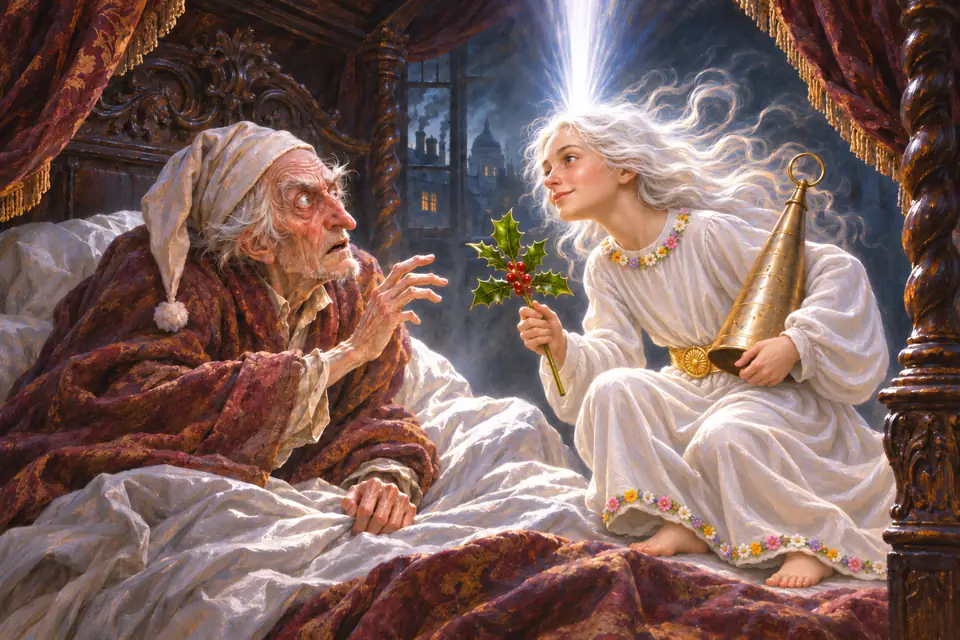
  1. The clock strikes one and the curtains of Scrooge’s bed are pulled aside. The first Spirit is a strange figure, like a child: yet not so like a child as like an old man, with a bright clear jet of light shining from its head.

    The Ghost of Christmas Past, a gentle, white-haired figure in a long white tunic with light streaming from its head, sits at the foot of Scrooge's bed as he half rises in his nightcap.
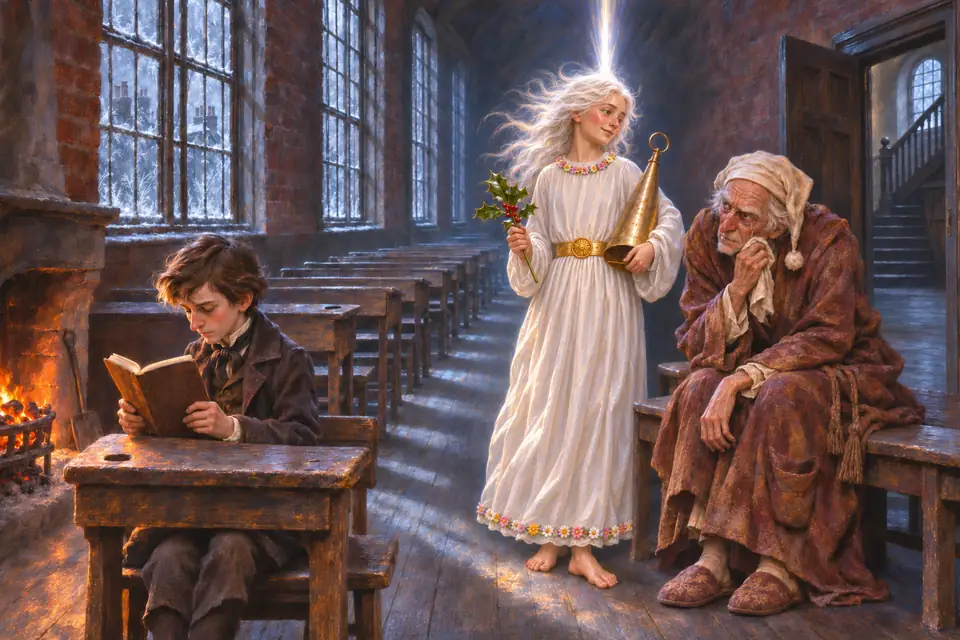
  2. They travel to the countryside where Scrooge grew up. He sees himself as a boy, left alone at school at Christmas: A solitary child, neglected by his friends. Scrooge cries, and wishes he had given something to the boy who sang a carol at his door.

    In a bare schoolroom a lonely boy reads by a feeble fire, while old Scrooge and the Ghost watch and old Scrooge weeps.
  3. Some years later his little sister, Fan, comes to take him home: Father is so much kinder than he used to be. The Ghost reminds Scrooge that Fan died young, and that her son is his nephew, Fred.

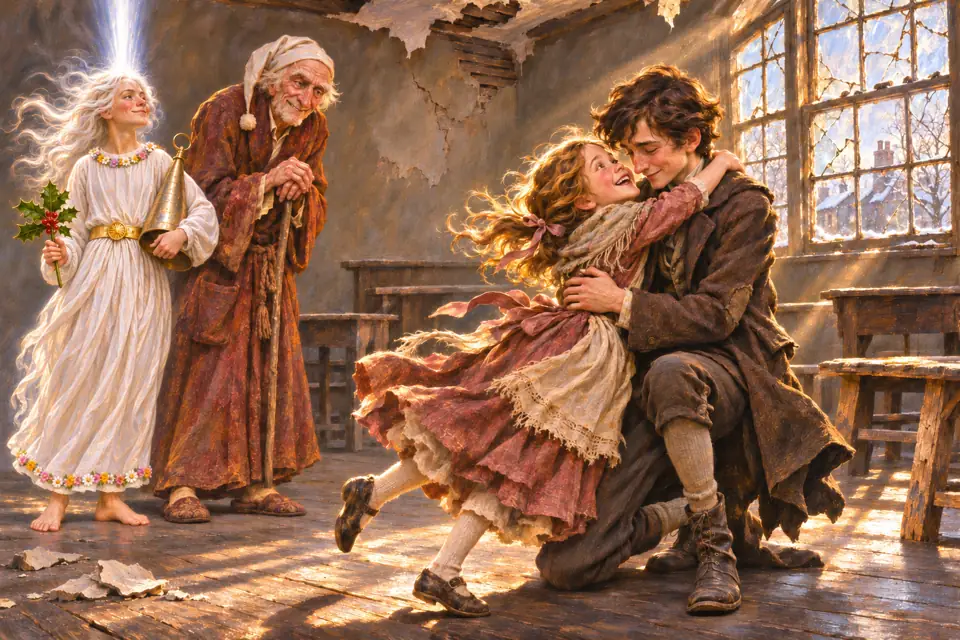
    A little girl rushes into the old schoolroom and throws her arms round her brother's neck.
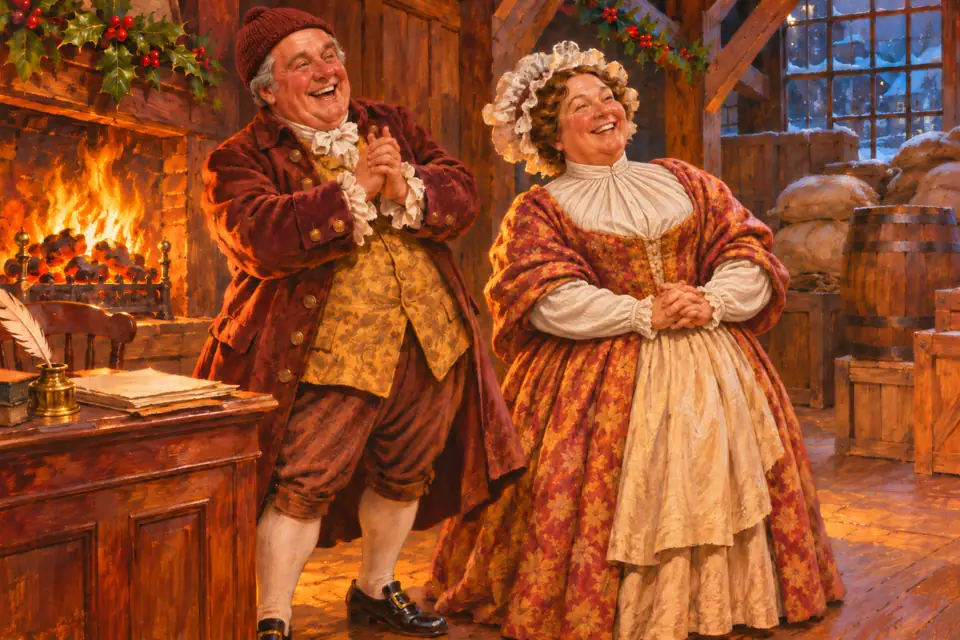
  4. Scrooge watches the Christmas Eve party that his old boss, Fezziwig, gave for his apprentices and workers. Scrooge says Fezziwig’s kindness was worth a fortune, then thinks of his own clerk.

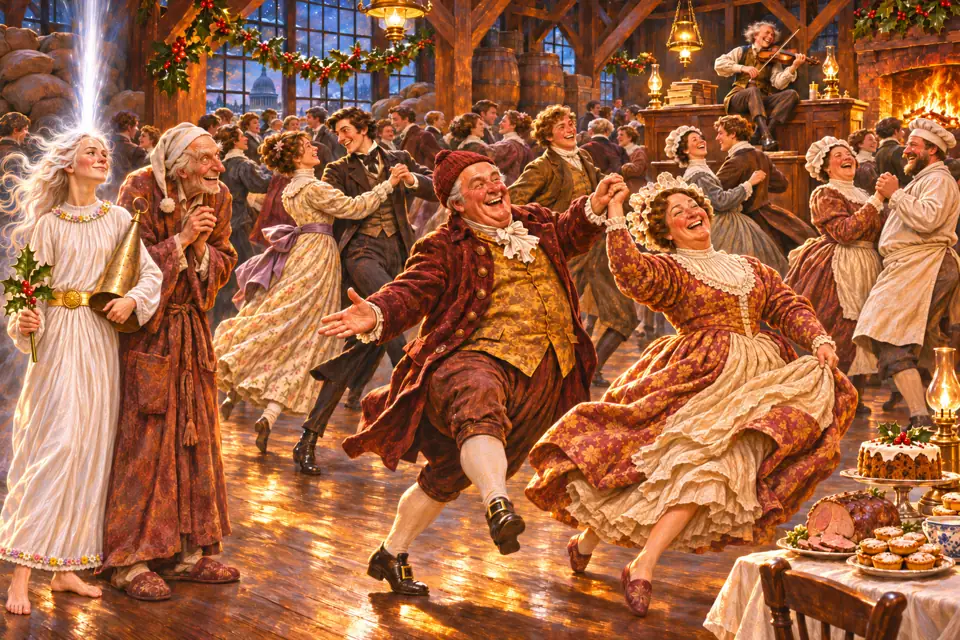
    Old Fezziwig and Mrs Fezziwig lead a joyful dance in the warehouse while young Scrooge dances behind them and old Scrooge watches, smiling.
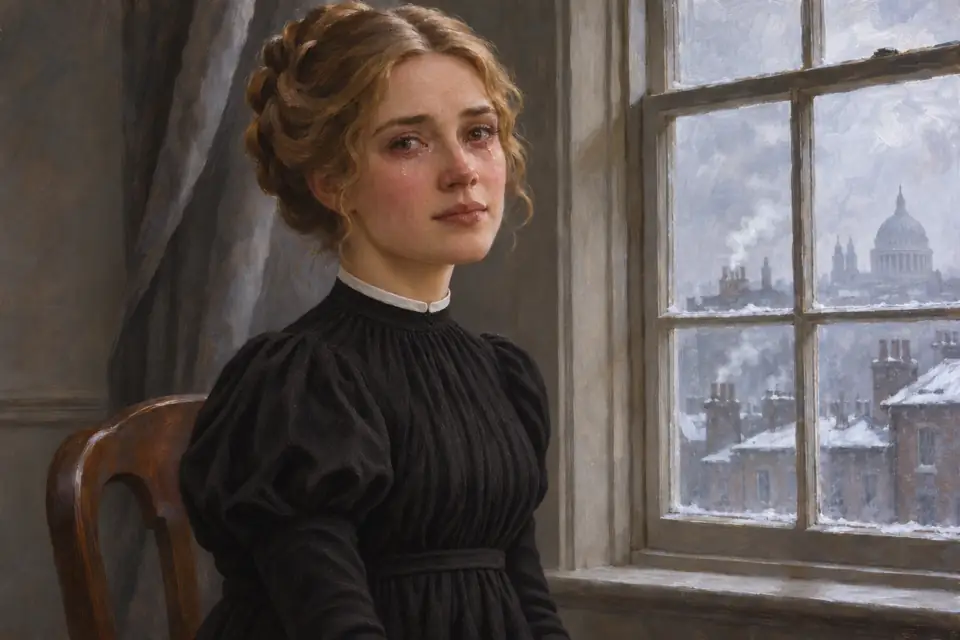
  5. Now a young man, Scrooge sits with Belle, the woman he was going to marry. She sets him free from their engagement because Another idol has displaced me: money.

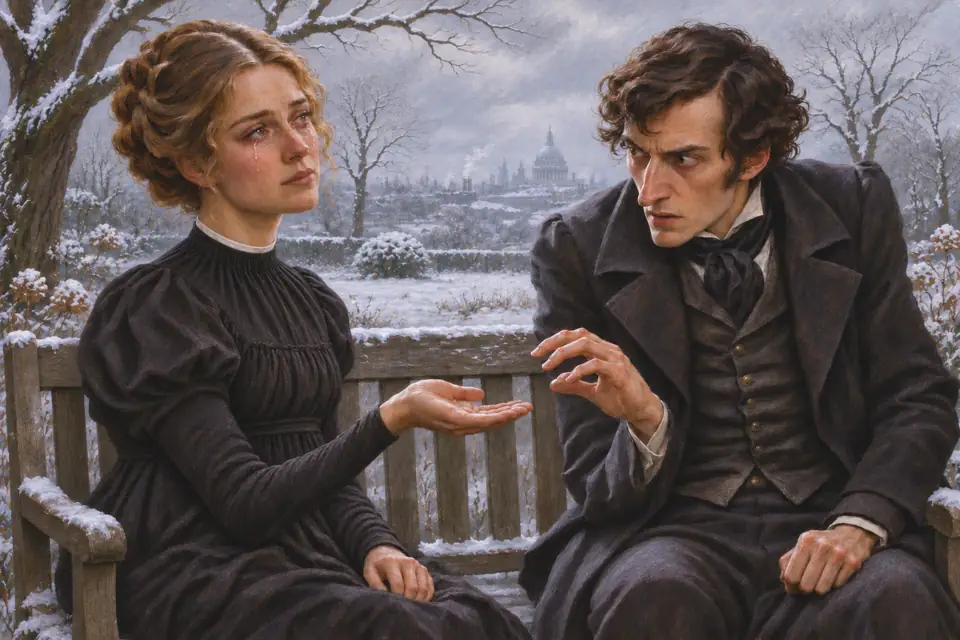
    Outdoors on a winter bench, young Scrooge, already with a restless, greedy look, sits beside Belle in her black mourning dress; tears in her eyes, she holds out an open hand as she releases him.
  6. Years later, Scrooge sees Belle as a happy mother in a noisy, loving home. Her husband says he saw Scrooge that afternoon, while Marley lay dying, Quite alone in the world.

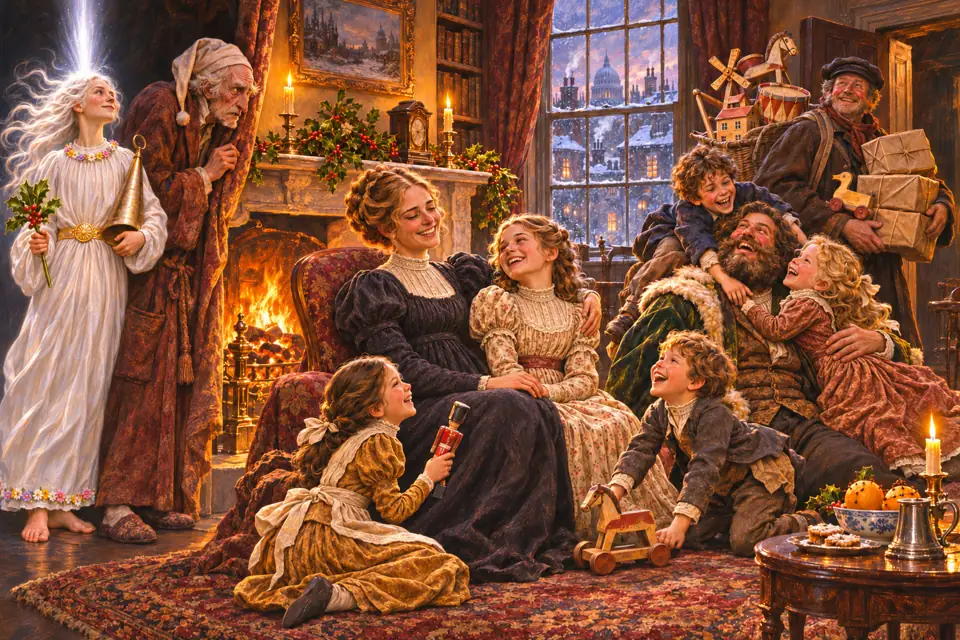
    Belle, now a happy mother, sits by the fire as children climb over their father, who has come home with Christmas presents.
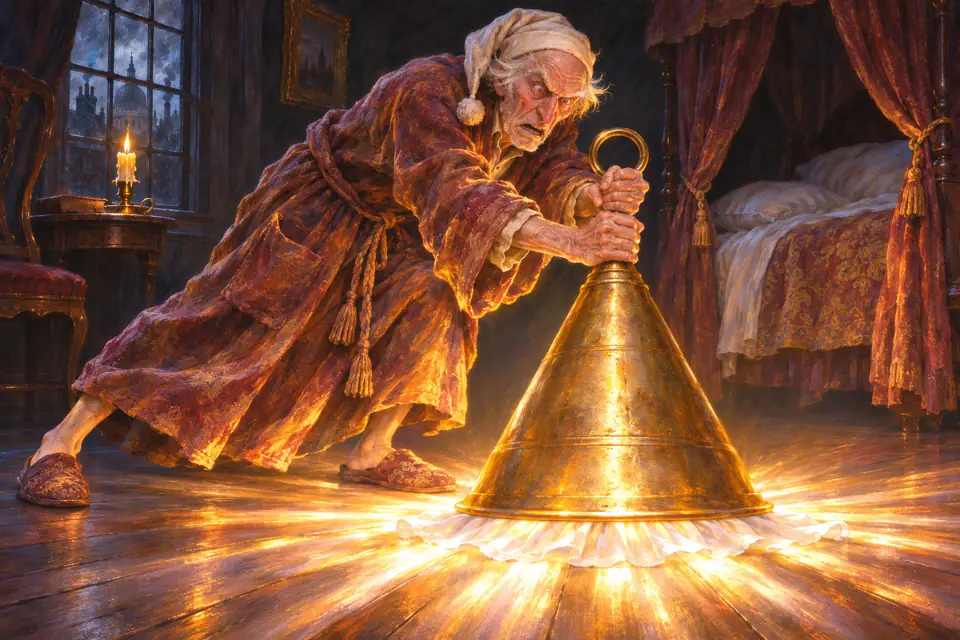
  7. Scrooge begs the Spirit to remove me from this place. He pushes its cap down over its head, but the light still pours out from underneath. Worn out, he falls asleep.

    Scrooge presses a huge cone-shaped cap down over the Ghost, but light floods out from under it onto the floor.

Key extracts

Read the extract: Fezziwig’s power to make people happy (207 words)

For a moment Scrooge speaks like his former, not his latter, self. Here his regret turns to his own clerk, Bob.

“A small matter,” said the Ghost, “to make these silly folks so full of gratitude.”

“Small!” echoed Scrooge.

The Spirit signed to him to listen to the two apprentices, who were pouring out their hearts in praise of Fezziwig: and when he had done so, said,

“Why! Is it not? He has spent but a few pounds of your mortal money: three or four perhaps. Is that so much that he deserves this praise?”

“It isn’t that,” said Scrooge, heated by the remark, and speaking unconsciously like his former, not his latter, self. “It isn’t that, Spirit. He has the power to render us happy or unhappy; to make our service light or burdensome; a pleasure or a toil. Say that his power lies in words and looks; in things so slight and insignificant that it is impossible to add and count ’em up: what then? The happiness he gives, is quite as great as if it cost a fortune.”

He felt the Spirit’s glance, and stopped.

“What is the matter?” asked the Ghost.

“Nothing particular,” said Scrooge.

“Something, I think?” the Ghost insisted.

“No,” said Scrooge, “No. I should like to be able to say a word or two to my clerk just now. That’s all.”

Highlighted words match the numbered quotation cards below.

Read the extract: Belle sets Scrooge free (AQA printed this in June 2023) (402 words)

Greed costs Scrooge the love of his life. This is the exact extract from the June 2023 paper.

This was not addressed to Scrooge, or to any one whom he could see, but it produced an immediate effect. For again Scrooge saw himself. He was older now; a man in the prime of life. His face had not the harsh and rigid lines of later years; but it had begun to wear the signs of care and avarice. There was an eager, greedy, restless motion in the eye, which showed the passion that had taken root, and where the shadow of the growing tree would fall.

He was not alone, but sat by the side of a fair young girl in a mourning-dress: in whose eyes there were tears, which sparkled in the light that shone out of the Ghost of Christmas Past.

“It matters little,” she said, softly. “To you, very little. Another idol has displaced me; and if it can cheer and comfort you in time to come, as I would have tried to do, I have no just cause to grieve.”

“What Idol has displaced you?” he rejoined.

“A golden one.”

“This is the even-handed dealing of the world!” he said. “There is nothing on which it is so hard as poverty; and there is nothing it professes to condemn with such severity as the pursuit of wealth!”

“You fear the world too much,” she answered, gently. “All your other hopes have merged into the hope of being beyond the chance of its sordid reproach. I have seen your nobler aspirations fall off one by one, until the master-passion, Gain, engrosses you. Have I not?”

“What then?” he retorted. “Even if I have grown so much wiser, what then? I am not changed towards you.”

She shook her head.

“Am I?”

“Our contract is an old one. It was made when we were both poor and content to be so, until, in good season, we could improve our worldly fortune by our patient industry. You are changed. When it was made, you were another man.”

“I was a boy,” he said impatiently.

“Your own feeling tells you that you were not what you are,” she returned. “I am. That which promised happiness when we were one in heart, is fraught with misery now that we are two. How often and how keenly I have thought of this, I will not say. It is enough that I have thought of it, and can release you.

Highlighted words match the numbered quotation cards below.

Quotation bank AO2

1
like a child: yet not so like a child as like an old man
Paradox

The Spirit is young and old at once, just as memories bring back our young selves while we are old.

2
a bright clear jet of light
Symbol

Light stands for truth and memory. The Spirit lights up the past that Scrooge has tried to forget.

3
A solitary child, neglected by his friends, is left there still.
Echo

Solitary echoes solitary as an oyster in Stave One. We learn that his loneliness began when he was a child, which makes us pity him.

4
Father is so much kinder than he used to be
Hint of backstory

Suggests Scrooge’s father was once harsh. Dickens hints at why Scrooge grew so cold, without excusing him.

5
He has the power to render us happy or unhappy
Contrast

Scrooge praises a kind boss, then remembers how he treats Bob. Without meaning to, he has judged himself.

In an extract above
6
The happiness he gives, is quite as great as if it cost a fortune.
Moral message

Kindness costs little but is worth a lot. This is one of Dickens’s key ideas.

In an extract above
7
There was an eager, greedy, restless motion in the eye
List of adjectives

Greed shows in his body. Restless suggests money never satisfies him.

In an extract above
8
Another idol has displaced me
Religious metaphor

An idol is a false god. Money has become Scrooge’s god and has pushed Belle out of his heart.

In an extract above
9
A golden one.
Short sentence

Belle’s three-word answer is final. Gold is what he worships now.

In an extract above

Check yourself

Why is young Scrooge alone at school?

He has been left there at Christmas while the other boys have gone home.

Who is Fan, and who is her son?

Scrooge’s younger sister. Her son is Fred, Scrooge’s nephew.

What does Belle say has taken her place in Scrooge’s heart?

An idol: A golden one. She means money.

Back to the five staves

3

Stave Three

The Second of the Three Spirits

The jolly Ghost of Christmas Present shows Scrooge how everyone, rich or poor, keeps Christmas, and warns him that Tiny Tim will die unless the future changes.

Printed in a real exam. June 2017: how the Cratchit family show the struggles of the poor; November 2020: the suffering of the poor; June 2025: the importance of kindness.
WhenChristmas morning at first; the visit seems to take in the whole Christmas holiday before the Spirit vanishes at midnight.
WhereLondon’s streets, the Cratchits’ home in Camden Town, Fred’s house, and places across land and sea.
MoodWarm, joyful and generous, turning dark at the very end.

What happens

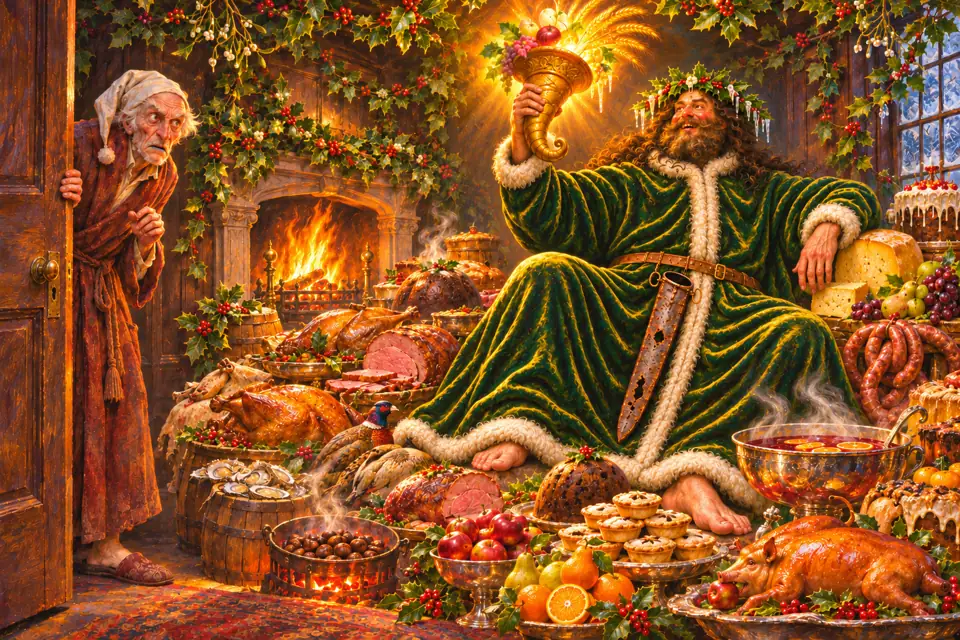
  1. Scrooge finds his room turned into a green grove, with a mountain of food piled up like a throne. On it sits the Ghost of Christmas Present, a jolly Giant, glorious to see.

    Scrooge's room hung with holly; the giant Spirit sits on a heap of turkeys, puddings and fruit, holding up a glowing torch as Scrooge peeps round the door.
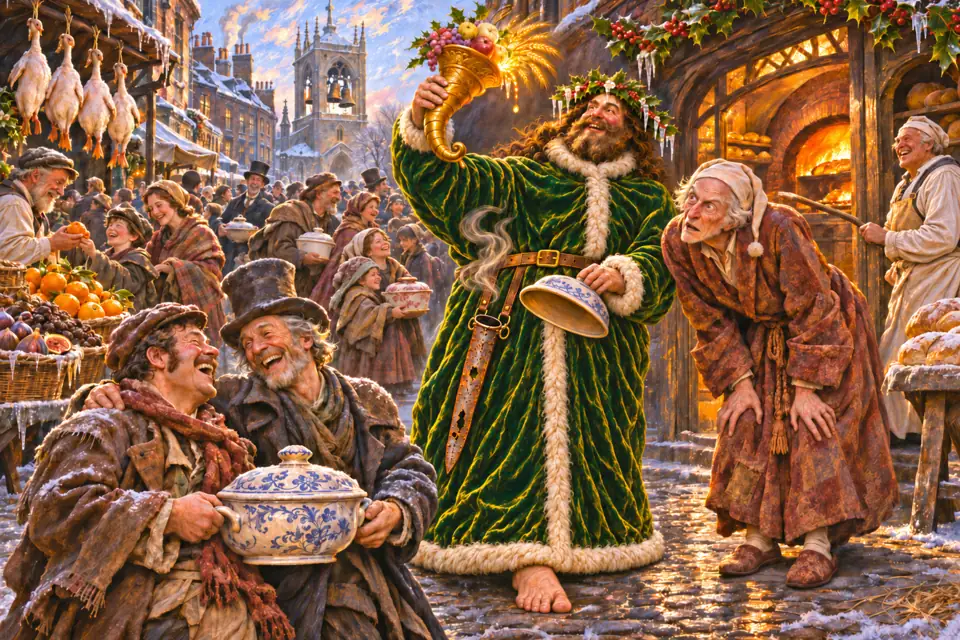
  2. On Christmas morning they walk through busy, happy streets full of shops. The Spirit blesses the dinners of the poor with incense from his torch, and when people carrying their dinners quarrel, a few drops of water from it make them cheerful again.

    In a busy Christmas street the giant Spirit stands in a baker's doorway holding a dish cover he has lifted, blessing poor families' dinners with a glow from his torch.
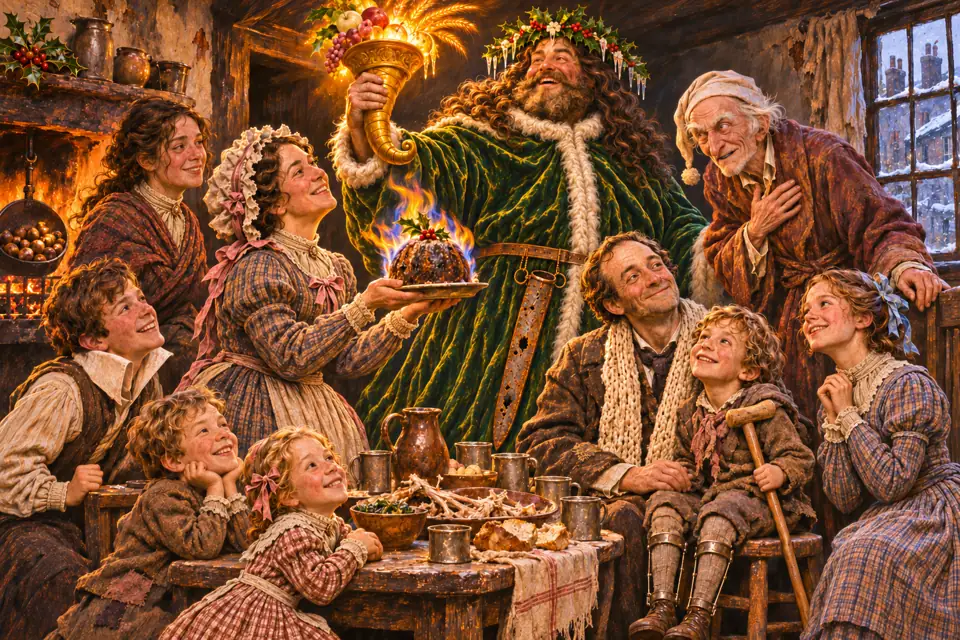
  3. At the Cratchits’ small home the family make a feast of a little goose and a pudding. Tiny Tim says God bless us every one! Scrooge asks if Tim will live. The Spirit says the child will die unless the future changes, and throws Scrooge’s own words about the surplus population back at him.

    The Cratchit family cheer as Mrs Cratchit carries in a flaming pudding, Tiny Tim beside Bob, while Scrooge and the Spirit watch from the door.
  4. Bob toasts Mr Scrooge as the Founder of the Feast, although Mrs Cratchit is angry. Then the Spirit carries Scrooge far away: miners on a bleak moor, two lighthouse keepers on a rock at sea, and sailors on a ship all keep Christmas.

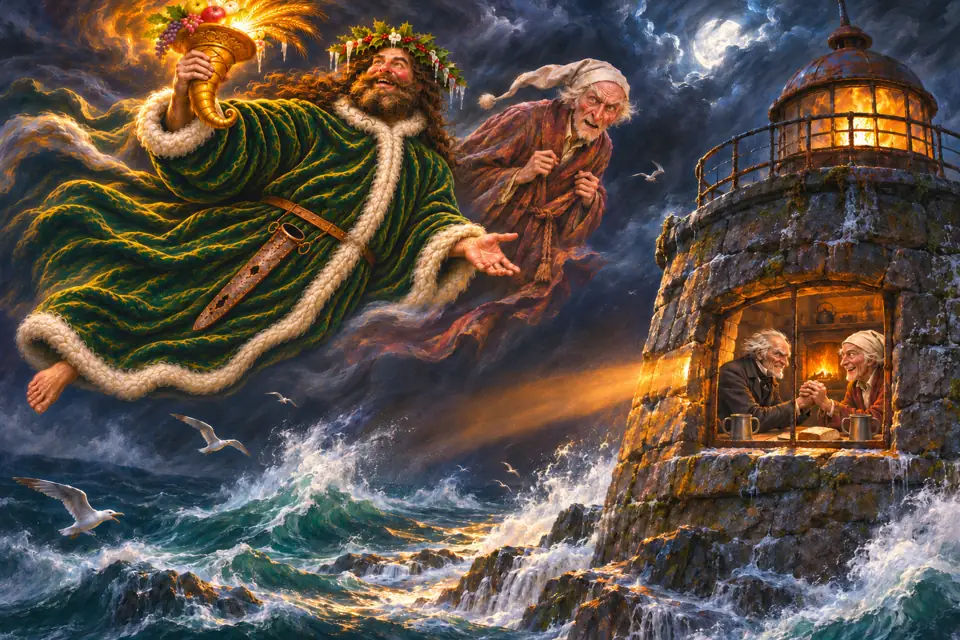
    A lonely lighthouse on rocks in a stormy sea at night; through its window two keepers shake hands over Christmas, while the Spirit and Scrooge fly overhead.
  5. At Fred’s party the guests laugh at Scrooge’s meanness, but Fred says I am sorry for him. Scrooge, unseen, joins in the games so happily that he begs to stay.

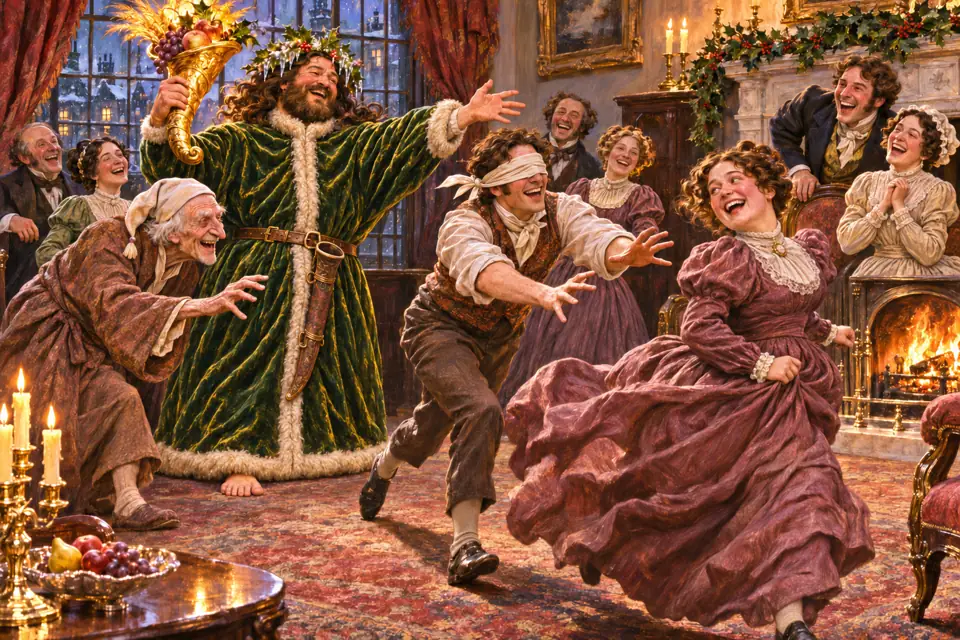
    A game of blind man's buff at Fred's lively party; unseen, Scrooge laughs and joins in beside the Spirit.
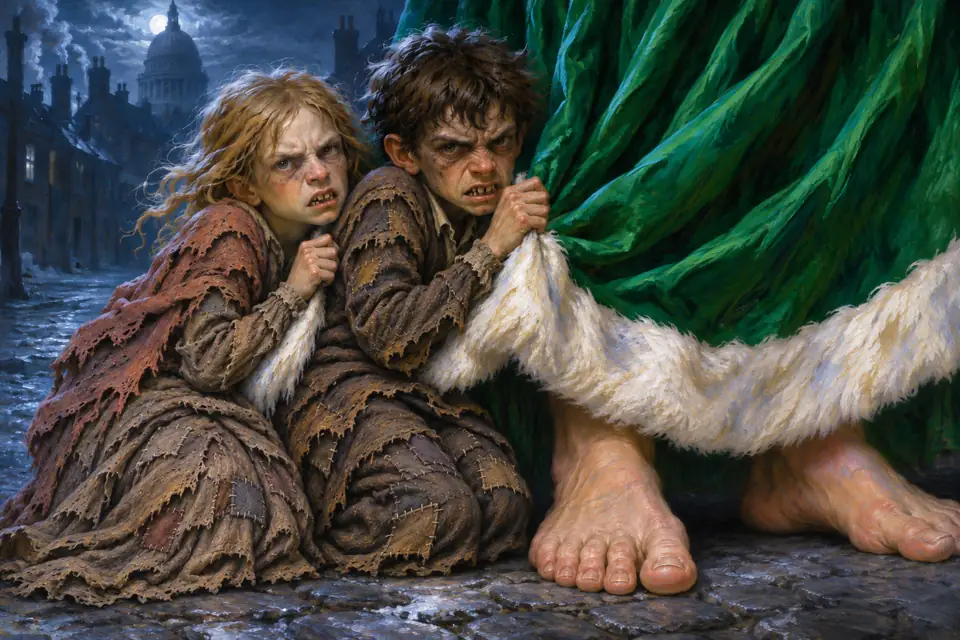
  6. The Spirit grows old. From under his robe he shows two starving children: This boy is Ignorance. This girl is Want. When Scrooge asks if they have no help, the Spirit answers with Scrooge’s own words: Are there no prisons?

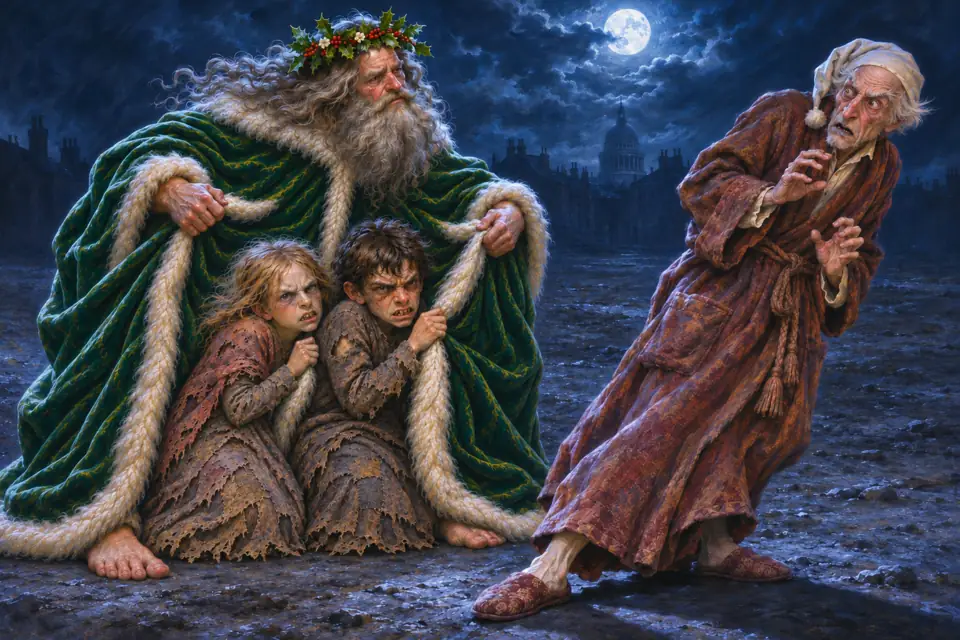
    The aged Spirit opens his green robe to show two thin, scowling children in long rags at his feet; Scrooge starts back in horror.

Key extracts

Read the extract: The Cratchits’ Christmas toast (AQA printed this in June 2025) (442 words)

Love in a poor home, Scrooge’s new care for Tiny Tim, and the moment his own cruel words come back to shame him. This is the exact extract from the June 2025 paper, used in the model answer.

At last the dinner was all done, the cloth was cleared, the hearth swept, and the fire made up. The compound in the jug being tasted, and considered perfect, apples and oranges were put upon the table, and a shovel-full of chestnuts on the fire. Then all the Cratchit family drew round the hearth, in what Bob Cratchit called a circle, meaning half a one; and at Bob Cratchit’s elbow stood the family display of glass. Two tumblers, and a custard-cup without a handle.

These held the hot stuff from the jug, however, as well as golden goblets would have done; and Bob served it out with beaming looks, while the chestnuts on the fire sputtered and cracked noisily. Then Bob proposed:

“A Merry Christmas to us all, my dears. God bless us!”

Which all the family re-echoed.

“God bless us every one!” said Tiny Tim, the last of all.

He sat very close to his father’s side upon his little stool. Bob held his withered little hand in his, as if he loved the child, and wished to keep him by his side, and dreaded that he might be taken from him.

“Spirit,” said Scrooge, with an interest he had never felt before, “tell me if Tiny Tim will live.”

“I see a vacant seat,” replied the Ghost, “in the poor chimney-corner, and a crutch without an owner, carefully preserved. If these shadows remain unaltered by the Future, the child will die.”

“No, no,” said Scrooge. “Oh, no, kind Spirit! say he will be spared.”

“If these shadows remain unaltered by the Future, none other of my race,” returned the Ghost, “will find him here. What then? If he be like to die, he had better do it, and decrease the surplus population.”

Scrooge hung his head to hear his own words quoted by the Spirit, and was overcome with penitence and grief.

“Man,” said the Ghost, “if man you be in heart, not adamant, forbear that wicked cant until you have discovered What the surplus is, and Where it is. Will you decide what men shall live, what men shall die? It may be, that in the sight of Heaven, you are more worthless and less fit to live than millions like this poor man’s child. Oh God! to hear the Insect on the leaf pronouncing on the too much life among his hungry brothers in the dust!”

Scrooge bent before the Ghost’s rebuke, and trembling cast his eyes upon the ground. But he raised them speedily, on hearing his own name.

“Mr. Scrooge!” said Bob; “I’ll give you Mr. Scrooge, the Founder of the Feast!”

Highlighted words match the numbered quotation cards below.

Read the extract: Ignorance and Want (AQA printed this in 2020) (369 words)

Dickens’s most direct warning to his readers about poverty. This is the extract AQA printed in its 2020 paper.

The chimes were ringing the three quarters past eleven at that moment.

“Forgive me if I am not justified in what I ask,” said Scrooge, looking intently at the Spirit’s robe, “but I see something strange, and not belonging to yourself, protruding from your skirts. Is it a foot or a claw?”

“It might be a claw, for the flesh there is upon it,” was the Spirit’s sorrowful reply. “Look here.”

From the foldings of its robe, it brought two children; wretched, abject, frightful, hideous, miserable. They knelt down at its feet, and clung upon the outside of its garment.

“Oh, Man! look here. Look, look, down here!” exclaimed the Ghost.

They were a boy and girl. Yellow, meagre, ragged, scowling, wolfish; but prostrate, too, in their humility. Where graceful youth should have filled their features out, and touched them with its freshest tints, a stale and shrivelled hand, like that of age, had pinched, and twisted them, and pulled them into shreds. Where angels might have sat enthroned, devils lurked, and glared out menacing. No change, no degradation, no perversion of humanity, in any grade, through all the mysteries of wonderful creation, has monsters half so horrible and dread.

Scrooge started back, appalled. Having them shown to him in this way, he tried to say they were fine children, but the words choked themselves, rather than be parties to a lie of such enormous magnitude.

“Spirit! are they yours?” Scrooge could say no more.

“They are Man’s,” said the Spirit, looking down upon them. “And they cling to me, appealing from their fathers. This boy is Ignorance. This girl is Want. Beware them both, and all of their degree, but most of all beware this boy, for on his brow I see that written which is Doom, unless the writing be erased. Deny it!” cried the Spirit, stretching out its hand towards the city. “Slander those who tell it ye! Admit it for your factious purposes, and make it worse. And bide the end!”

“Have they no refuge or resource?” cried Scrooge.

“Are there no prisons?” said the Spirit, turning on him for the last time with his own words. “Are there no workhouses?”

The bell struck twelve.

Highlighted words match the numbered quotation cards below.

Quotation bank AO2

1
a jolly Giant, glorious to see
Description

The Spirit is huge, warm and generous, the opposite of the shrivelled Scrooge.

2
in shape not unlike Plenty’s horn
Allusion

The horn of plenty is an ancient symbol of endless food. This Spirit stands for sharing, and for having more than enough.

3
fifteen “Bob” a-week
Pun

Bob earns fifteen shillings (‘bob’) a week: a modest wage to feed a family of eight. The joke on his name makes his poverty personal.

4
God bless us every one!
Exclamation, blessing

Tiny Tim’s blessing is for everyone, even Scrooge. The weakest child has the biggest heart.

In an extract above
5
If these shadows remain unaltered by the Future, the child will die.
Conditional ("If")

Tim’s death is not fixed. If gives Scrooge, and the reader, the power to change it.

In an extract above
6
If he be like to die, he had better do it
Irony

The Spirit repeats Scrooge’s own cruel words. Now they are about a child he cares for, and they shame him.

In an extract above
7
the Founder of the Feast
Irony

Bob generously thanks Scrooge for the feast, because his wages paid for it. Mrs Cratchit’s angry echo reminds us how little Scrooge pays him.

In an extract above
8
This boy is Ignorance. This girl is Want.
Allegory

The children stand for the lack of education and the lack of food and money in society.

In an extract above
9
Are there no workhouses?
Repetition

The Spirit turns Scrooge’s words from Stave One on him for the last time. Scrooge cannot escape what he said.

In an extract above

Check yourself

How much does Bob Cratchit earn?

Fifteen shillings a week. A shilling was nicknamed a ‘bob’.

What does the Spirit say will happen to Tiny Tim if nothing changes?

He will die. The Spirit sees a crutch without an owner.

What are the names of the two children under the Spirit’s robe?

Ignorance (the boy) and Want (the girl).

Back to the five staves

4

Stave Four

The Last of the Spirits

The silent Ghost of Christmas Yet to Come shows Scrooge a future where he dies unloved and Tiny Tim is dead, and Scrooge begs for the chance to change.

Printed in a real exam. June 2018: Scrooge's fears; June 2024: the lessons Scrooge learns about life.
Used in a practice paper. Sample for 2022: Scrooge's fears (the 2018 question again).
WhenThe future. Dickens never says exactly when.
WhereThe City, a filthy back-street shop, a dark bedroom, the Cratchits’ home and a churchyard.
MoodDark, silent and frightening.

What happens

  1. A Phantom in a black hood glides slowly towards Scrooge. It never speaks; it points and gestures instead. Scrooge tells it: I fear you more than any spectre I have seen.

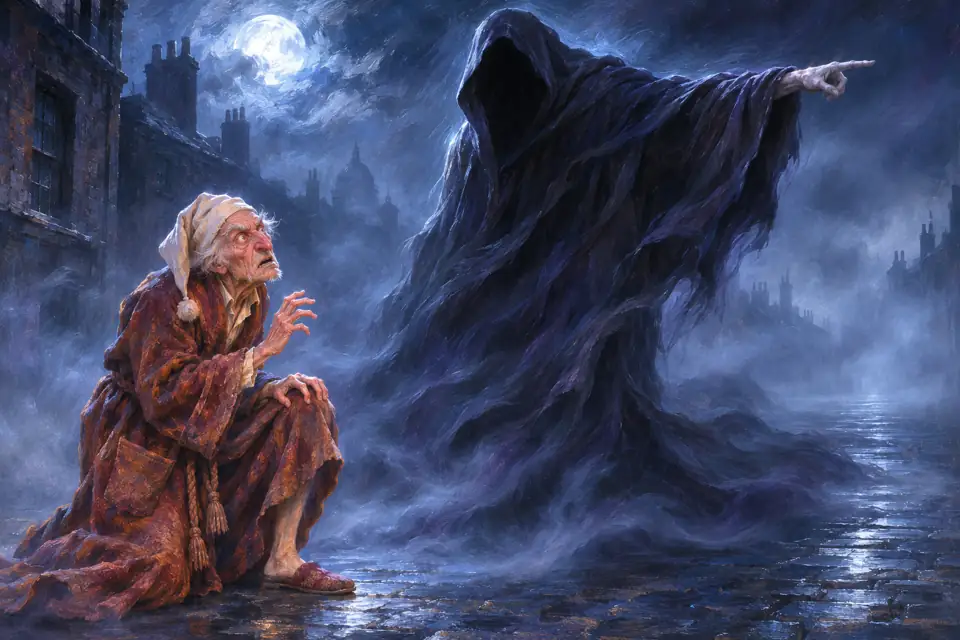
    In the dark, the hooded Phantom approaches with its hand held out as Scrooge sinks to one knee in fear.
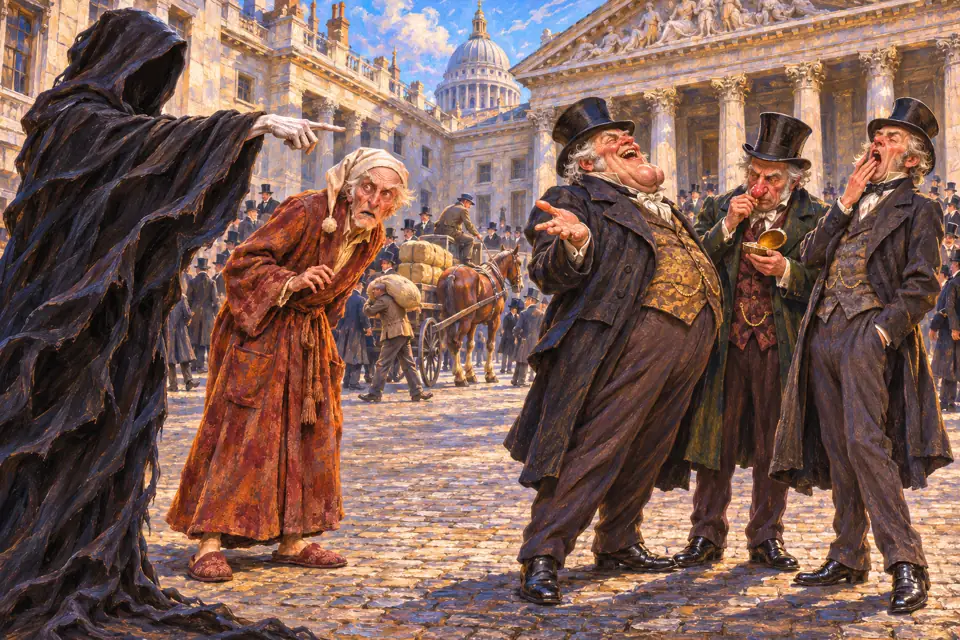
  2. In the City, businessmen joke about a man who has died. Nobody is sad. One says he will only go to the funeral if a lunch is provided.

    Businessmen in top hats chat and laugh in the City while the Phantom points at them and Scrooge listens, puzzled.
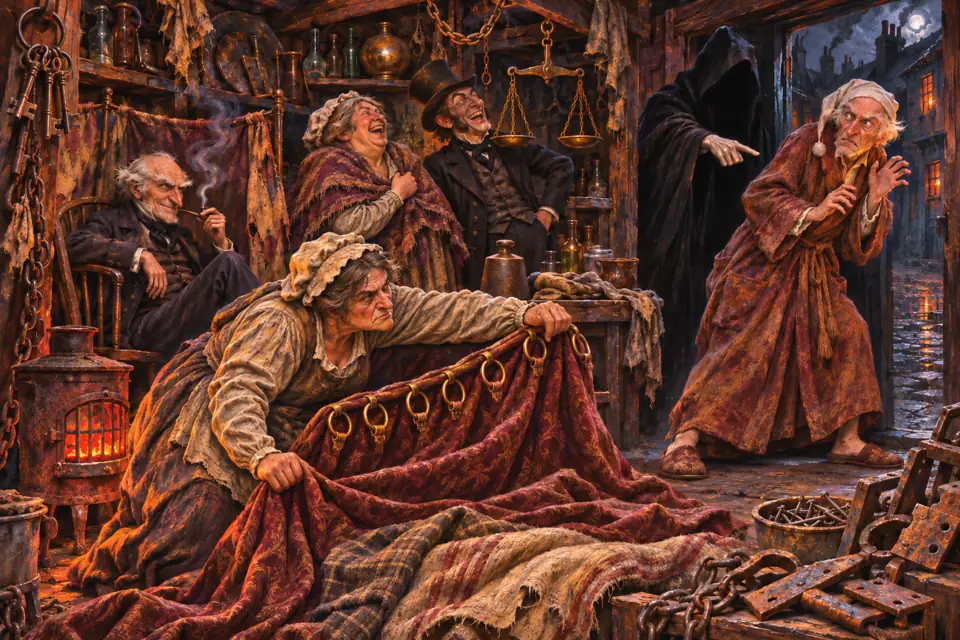
  3. In a filthy back street, a charwoman, a laundress and an undertaker’s man sell the dead man’s things to old Joe, a dealer in stolen goods. They have even taken his bed-curtains and the shirt he was to be buried in.

    In a cramped junk shop, a woman unrolls a bundle of bed-curtains for old Joe while others laugh; Scrooge and the Phantom watch from the shadows.
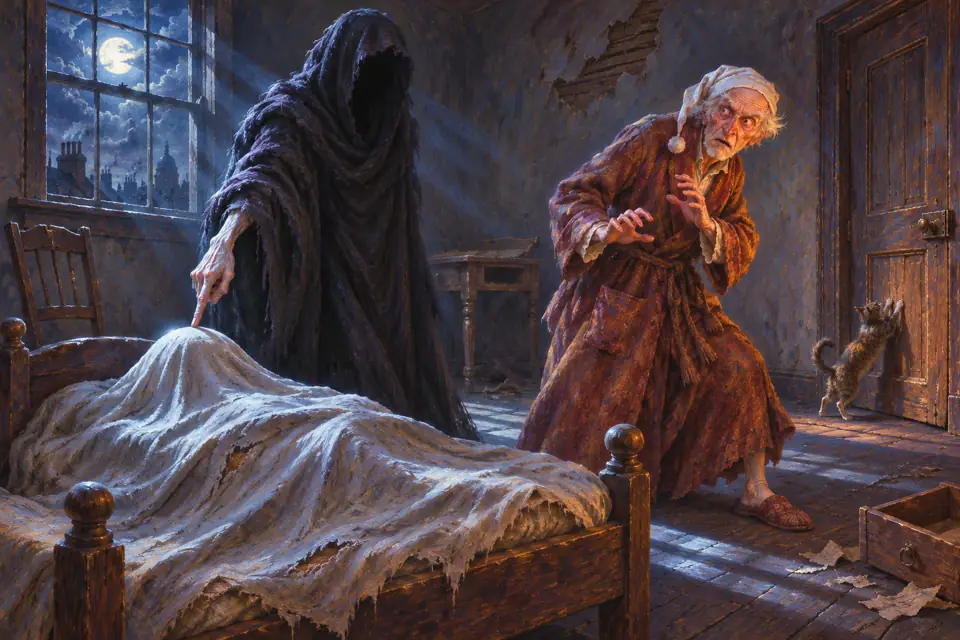
  4. Scrooge sees the dead man lying alone, unwatched, unwept, uncared for. The only feeling his death causes is relief, in a poor young couple who owed him money.

    A covered body lies on a bare bed with no curtains while the Phantom points to it and Scrooge shrinks back.
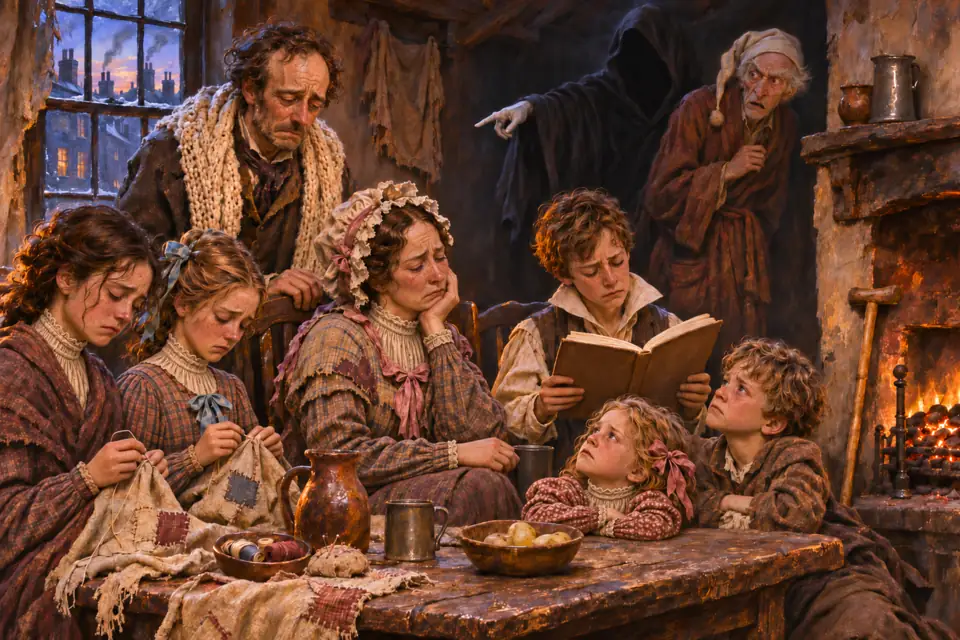
  5. At the Cratchits’ home the family are quiet and sad. Tiny Tim has died. Bob has been to see the place where he will be buried, and tries to be brave for the others.

    The Cratchit family sit quietly round a low fire; Tiny Tim's little crutch leans alone in the corner.
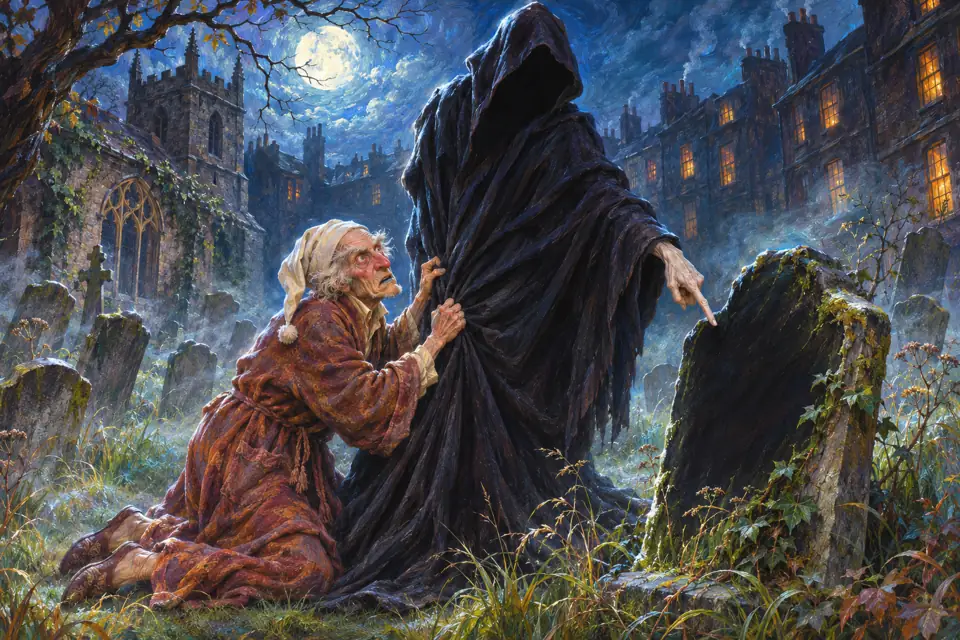
  6. In an overgrown churchyard the Phantom points to a neglected grave. On the stone Scrooge reads his own name. He begs to be given the chance to change: I will honour Christmas in my heart. The Phantom shrinks into his bedpost.

    In a weedy churchyard at night the Phantom points down at a shadowed gravestone while Scrooge kneels, clutching its robe and begging.

Key extracts

Read the extract: Old Joe’s shop and the dead man’s room (AQA printed this in June 2024) (509 words)

A greedy life ends in a death that nobody mourns, and that some people profit from. This is the exact extract from the June 2024 paper.

“Ha, ha!” laughed the same woman, when old Joe, producing a flannel bag with money in it, told out their several gains upon the ground. “This is the end of it, you see! He frightened every one away from him when he was alive, to profit us when he was dead! Ha, ha, ha!”

“Spirit!” said Scrooge, shuddering from head to foot. “I see, I see. The case of this unhappy man might be my own. My life tends that way, now. Merciful Heaven, what is this!”

He recoiled in terror, for the scene had changed, and now he almost touched a bed: a bare, uncurtained bed: on which, beneath a ragged sheet, there lay a something covered up, which, though it was dumb, announced itself in awful language.

The room was very dark, too dark to be observed with any accuracy, though Scrooge glanced round it in obedience to a secret impulse, anxious to know what kind of room it was. A pale light, rising in the outer air, fell straight upon the bed; and on it, plundered and bereft, unwatched, unwept, uncared for, was the body of this man.

Scrooge glanced towards the Phantom. Its steady hand was pointed to the head. The cover was so carelessly adjusted that the slightest raising of it, the motion of a finger upon Scrooge’s part, would have disclosed the face. He thought of it, felt how easy it would be to do, and longed to do it; but had no more power to withdraw the veil than to dismiss the spectre at his side.

Oh cold, cold, rigid, dreadful Death, set up thine altar here, and dress it with such terrors as thou hast at thy command: for this is thy dominion! But of the loved, revered, and honoured head, thou canst not turn one hair to thy dread purposes, or make one feature odious. It is not that the hand is heavy and will fall down when released; it is not that the heart and pulse are still; but that the hand WAS open, generous, and true; the heart brave, warm, and tender; and the pulse a man’s. Strike, Shadow, strike! And see his good deeds springing from the wound, to sow the world with life immortal!

No voice pronounced these words in Scrooge’s ears, and yet he heard them when he looked upon the bed. He thought, if this man could be raised up now, what would be his foremost thoughts? Avarice, hard-dealing, griping cares? They have brought him to a rich end, truly!

He lay, in the dark empty house, with not a man, a woman, or a child, to say that he was kind to me in this or that, and for the memory of one kind word I will be kind to him. A cat was tearing at the door, and there was a sound of gnawing rats beneath the hearth-stone. What they wanted in the room of death, and why they were so restless and disturbed, Scrooge did not dare to think.

Highlighted words match the numbered quotation cards below.
Read the extract: Scrooge’s grave (397 words)

The turning point of the whole novel. Scrooge’s promise here is what Stave Five keeps.

The Spirit stood among the graves, and pointed down to One. He advanced towards it trembling. The Phantom was exactly as it had been, but he dreaded that he saw new meaning in its solemn shape.

“Before I draw nearer to that stone to which you point,” said Scrooge, “answer me one question. Are these the shadows of the things that Will be, or are they shadows of things that May be, only?”

Still the Ghost pointed downward to the grave by which it stood.

“Men’s courses will foreshadow certain ends, to which, if persevered in, they must lead,” said Scrooge. “But if the courses be departed from, the ends will change. Say it is thus with what you show me!”

The Spirit was immovable as ever.

Scrooge crept towards it, trembling as he went; and following the finger, read upon the stone of the neglected grave his own name, EBENEZER SCROOGE.

“Am I that man who lay upon the bed?” he cried, upon his knees.

The finger pointed from the grave to him, and back again.

“No, Spirit! Oh no, no!”

The finger still was there.

“Spirit!” he cried, tight clutching at its robe, “hear me! I am not the man I was. I will not be the man I must have been but for this intercourse. Why show me this, if I am past all hope!”

For the first time the hand appeared to shake.

“Good Spirit,” he pursued, as down upon the ground he fell before it: “Your nature intercedes for me, and pities me. Assure me that I yet may change these shadows you have shown me, by an altered life!”

The kind hand trembled.

“I will honour Christmas in my heart, and try to keep it all the year. I will live in the Past, the Present, and the Future. The Spirits of all Three shall strive within me. I will not shut out the lessons that they teach. Oh, tell me I may sponge away the writing on this stone!”

In his agony, he caught the spectral hand. It sought to free itself, but he was strong in his entreaty, and detained it. The Spirit, stronger yet, repulsed him.

Holding up his hands in a last prayer to have his fate reversed, he saw an alteration in the Phantom’s hood and dress. It shrunk, collapsed, and dwindled down into a bedpost.

Highlighted words match the numbered quotation cards below.
Quotation bank AO2

1
The Phantom slowly, gravely, silently, approached.
Three adverbs

The slow list of adverbs, broken by commas, makes the Phantom’s arrival creep closer and closer.

2
shrouded in a deep black garment
Imagery of death

A shroud is the cloth wrapped round a dead body. The Spirit looks like death itself.

3
I fear you more than any spectre I have seen.
Admission

Scrooge fears the future most, because it holds his own death.

4
It’s likely to be a very cheap funeral
Dark humour

The businessmen joke about the death. A life spent making money ends in a cheap funeral that nobody wants to attend.

5
plundered and bereft, unwatched, unwept, uncared for
List and repeated prefix

The ‘un-’ words list everything the dead man lacks: nobody watches, weeps or cares.

In an extract above
6
Spirit of Tiny Tim, thy childish essence was from God!
Religious language

The narrator calls Tim’s goodness holy. His death would be a loss to the whole world.

7
Men’s courses will foreshadow certain ends
Key argument

Scrooge argues that the way we live leads to certain endings, but if we change our ways, the endings can change.

In an extract above
8
I will honour Christmas in my heart, and try to keep it all the year.
Promise

Christmas becomes a way of living all year round, not one day of parties.

In an extract above
9
dwindled down into a bedpost
Anticlimax

The terrifying Phantom turns into ordinary furniture. Scrooge is safe at home, and has a second chance.

In an extract above

Check yourself

Does the Ghost of Christmas Yet to Come ever speak?

No, never. It answers with gestures: it points, and once its hand trembles.

What do the three people sell to old Joe?

The dead man’s belongings, including his bed-curtains, his blankets and the shirt he was to be buried in.

Whose name is on the neglected gravestone?

Scrooge’s own name: Ebenezer Scrooge.

Back to the five staves

5

Stave Five

The End of It

Scrooge wakes up on Christmas morning a changed man, and spends the day, and the rest of his life, making up for lost time with joy and generosity.

WhenChristmas Day and the day after, then the rest of his life.
WhereScrooge’s bedroom, the streets, Fred’s house and the counting-house.
MoodJoyful, comic and full of light.

What happens

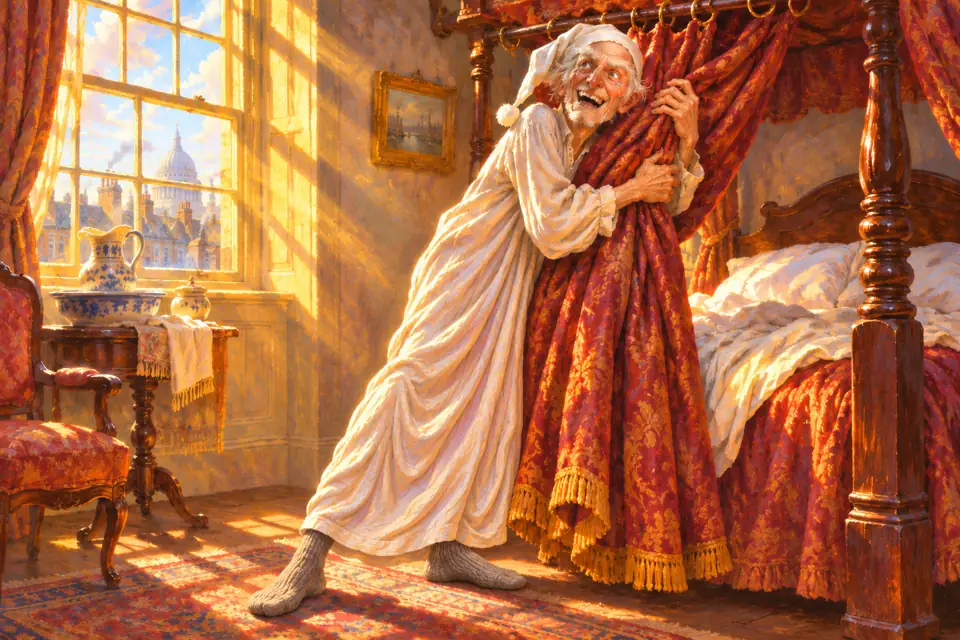
  1. Scrooge wakes in his own bed. It is not too late. He laughs and cries at once, hugs his bed-curtains (They are not torn down) and says he is as light as a feather.

    In bright morning light Scrooge, in a long nightshirt and nightcap, hugs his bed-curtain, laughing and crying at once.
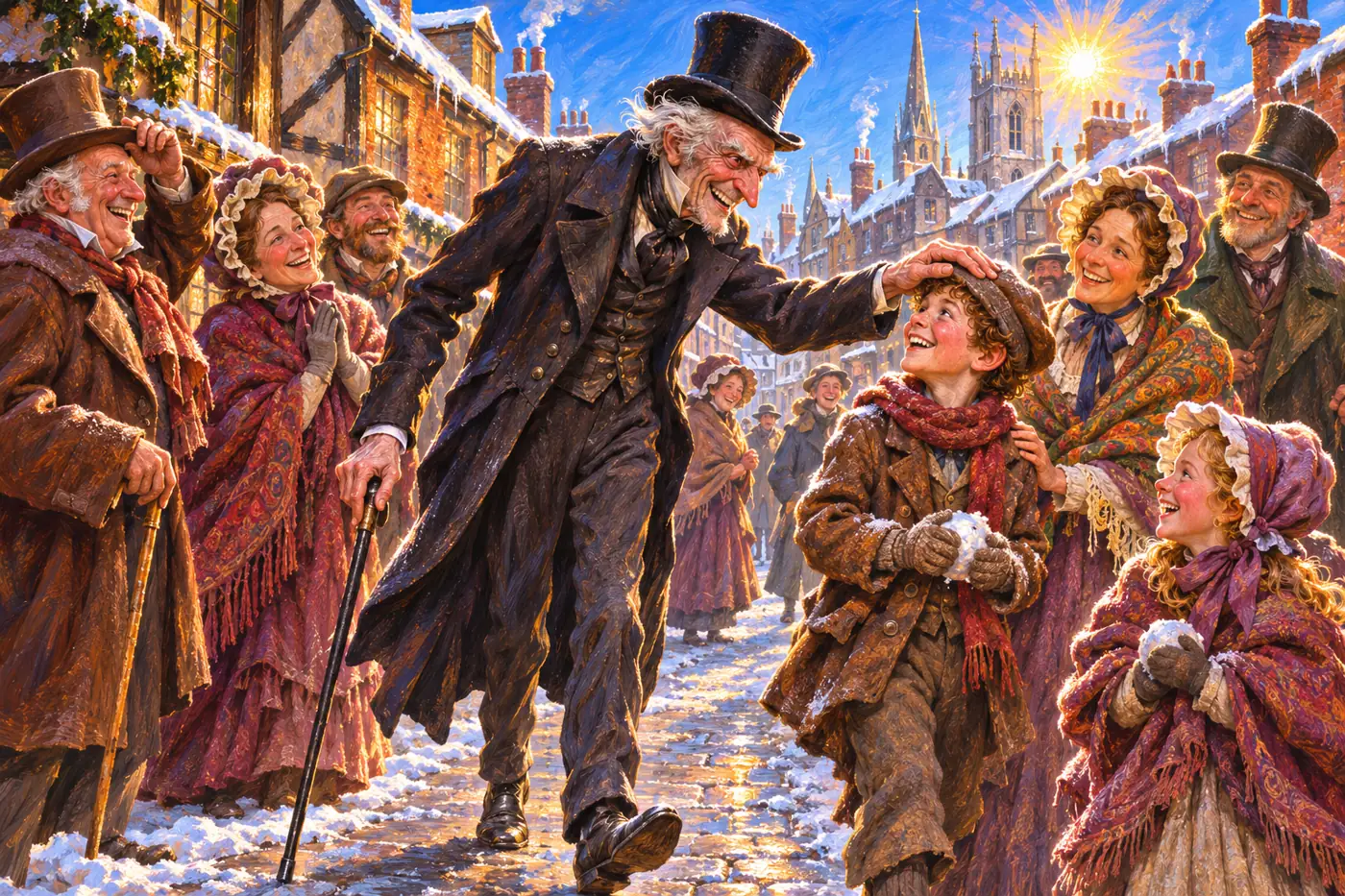
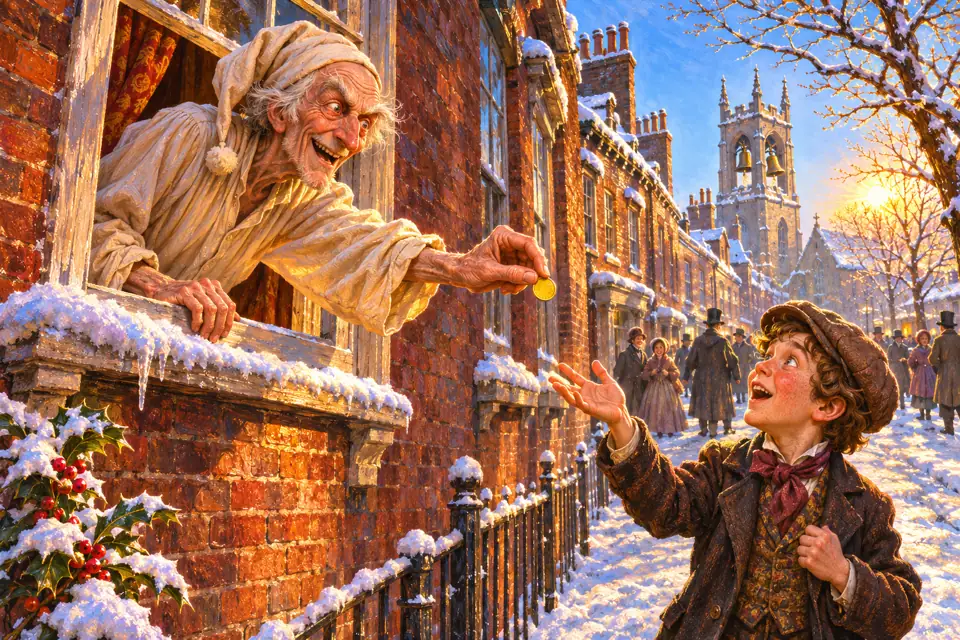
  2. He opens his window to a bright, cold morning and learns from a boy that it is Christmas Day. He pays the boy to fetch the prize turkey from the poulterer’s and sends it secretly to the Cratchits: It’s twice the size of Tiny Tim.

    Scrooge in his nightcap leans out of his window into golden sunlight, holding up a coin as he promises an astonished boy a reward for fetching the turkey.
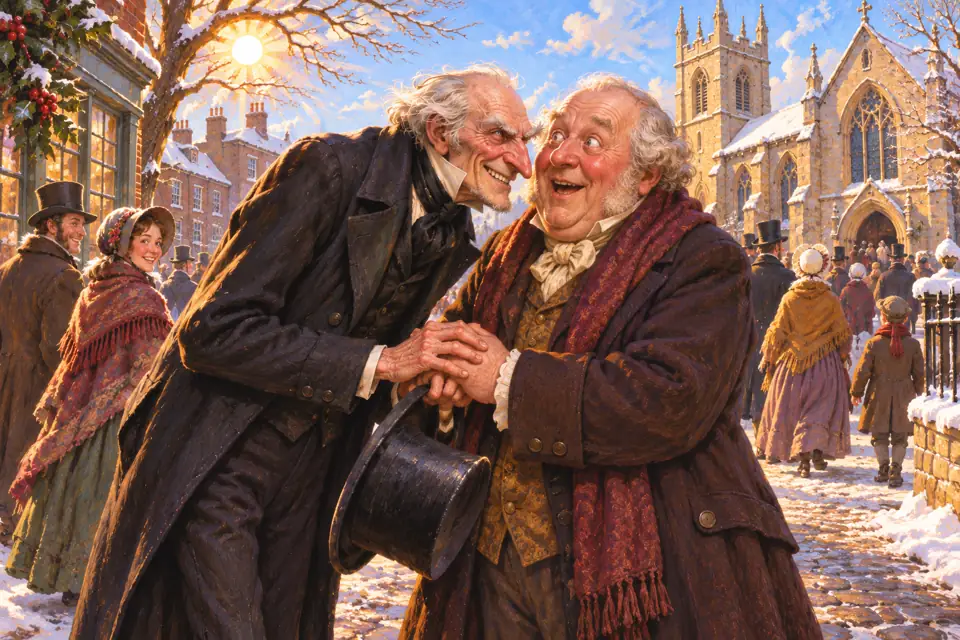
  3. In the street he meets one of the charity gentlemen and whispers a huge gift for the poor, with A great many back-payments included. He goes to church and walks happily through the streets.

    In his best clothes, Scrooge holds both hands of the astonished charity gentleman and whispers in his ear.
  4. At last he knocks on Fred’s door and is welcomed to Christmas dinner: Wonderful party, wonderful games.

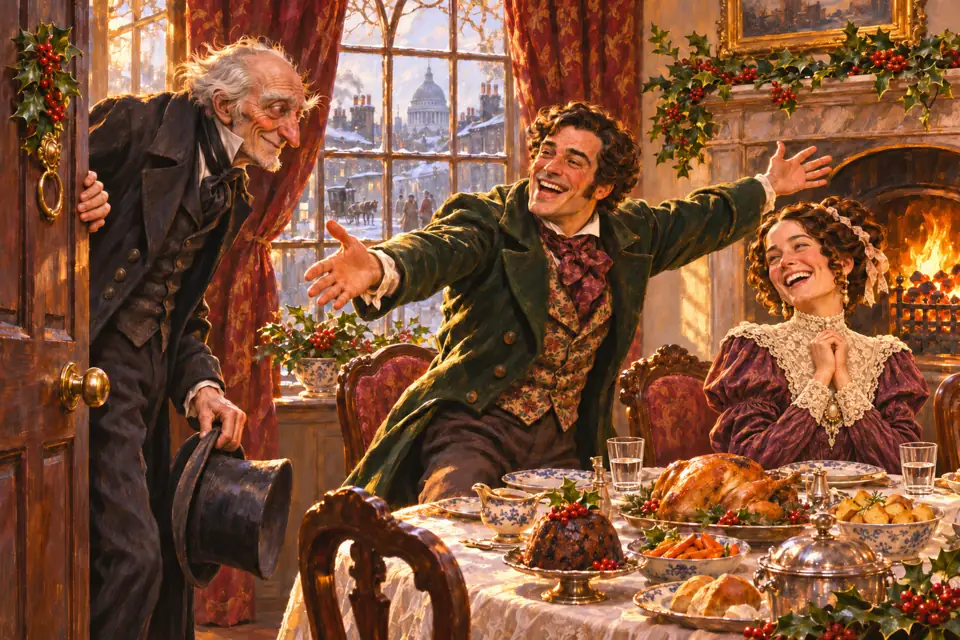
    Fred leaps up from the dinner table with arms wide as a shy, hopeful Scrooge appears at the door.
  5. The next morning Bob arrives late. Scrooge pretends to be angry, then tells him he will raise his salary and help his struggling family.

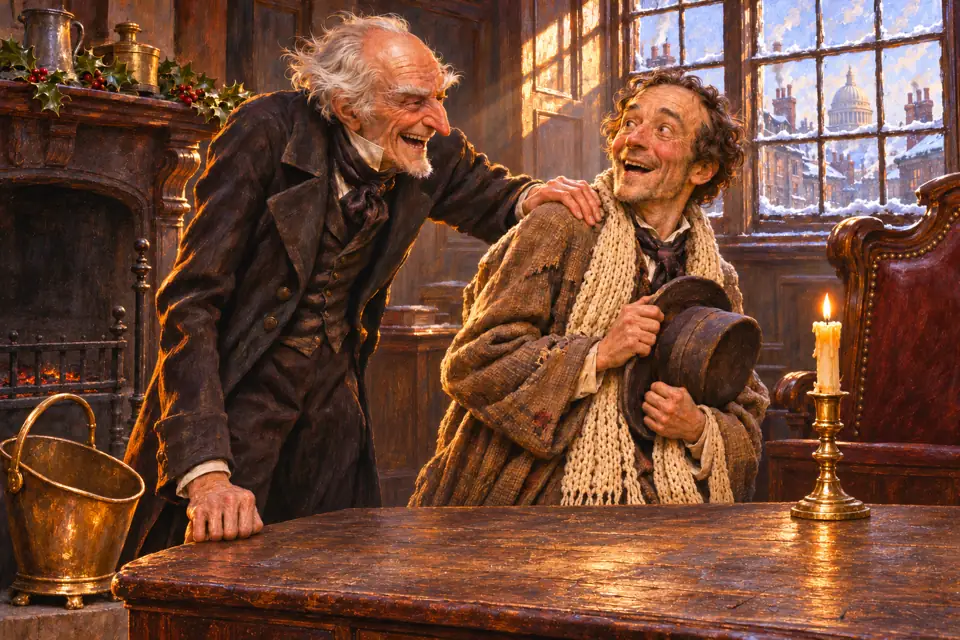
    In the still-cold office with its tiny fire, Scrooge laughs and claps an astonished Bob Cratchit on the back.
  6. Scrooge keeps his word. He becomes a second father to Tiny Tim, who did NOT die, and everyone says he knew how to keep Christmas well.

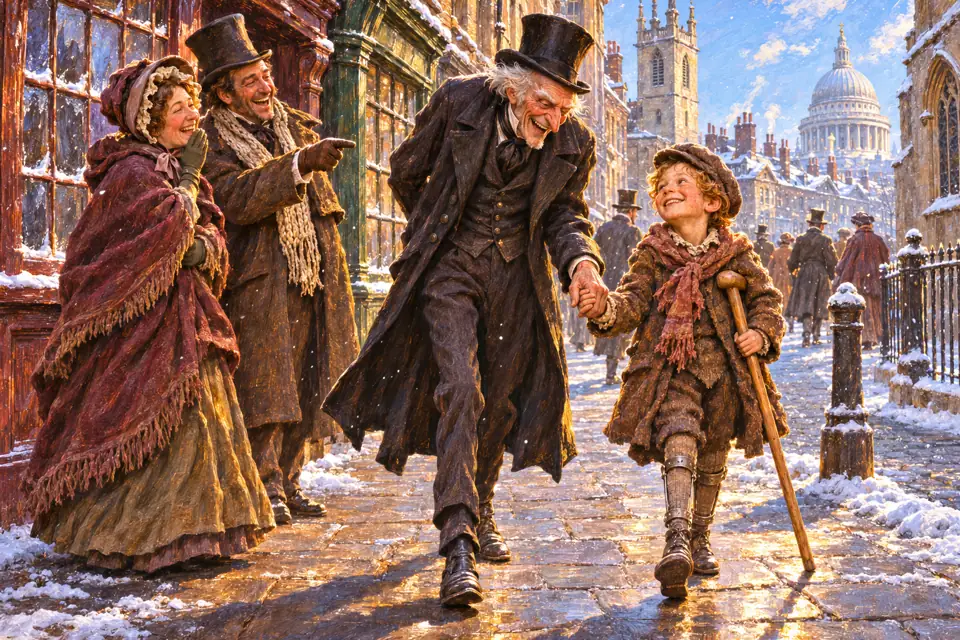
    On a bright, frosty City street, a smiling Scrooge in his best clothes walks hand in hand with a rosy Tiny Tim and his little crutch, while two passers-by point and laugh at the change in him.

Key extracts

Read the extract: Christmas morning at the window (127 words)

The weather has changed with Scrooge: no fog, just golden sunlight. Compare it with the fog and frost of Stave One.

Running to the window, he opened it, and put out his head. No fog, no mist; clear, bright, jovial, stirring, cold; cold, piping for the blood to dance to; Golden sunlight; Heavenly sky; sweet fresh air; merry bells. Oh, glorious! Glorious!

“What’s to-day!” cried Scrooge, calling downward to a boy in Sunday clothes, who perhaps had loitered in to look about him.

“EH?” returned the boy, with all his might of wonder.

“What’s to-day, my fine fellow?” said Scrooge.

“To-day!” replied the boy. “Why, CHRISTMAS DAY.”

“It’s Christmas Day!” said Scrooge to himself. “I haven’t missed it. The Spirits have done it all in one night. They can do anything they like. Of course they can. Of course they can. Hallo, my fine fellow!”

Highlighted words match the numbered quotation cards below.
Read the extract: The ending (213 words)

The last two paragraphs. Dickens tells us what Scrooge became, and turns Tiny Tim’s blessing to the reader.

Scrooge was better than his word. He did it all, and infinitely more; and to Tiny Tim, who did NOT die, he was a second father. He became as good a friend, as good a master, and as good a man, as the good old city knew, or any other good old city, town, or borough, in the good old world. Some people laughed to see the alteration in him, but he let them laugh, and little heeded them; for he was wise enough to know that nothing ever happened on this globe, for good, at which some people did not have their fill of laughter in the outset; and knowing that such as these would be blind anyway, he thought it quite as well that they should wrinkle up their eyes in grins, as have the malady in less attractive forms. His own heart laughed: and that was quite enough for him.

He had no further intercourse with Spirits, but lived upon the Total Abstinence Principle, ever afterwards; and it was always said of him, that he knew how to keep Christmas well, if any man alive possessed the knowledge. May that be truly said of us, and all of us! And so, as Tiny Tim observed, God bless Us, Every One!

Highlighted words match the numbered quotation cards below.
Quotation bank AO2

1
Yes! and the bedpost was his own.
Exclamation

The first words of the stave are pure relief. The bedpost that the Phantom shrank into is just a bedpost.

2
They are not torn down, rings and all.
Echo

In Stave Four the charwoman sold old Joe the dead man’s bed-curtains, taken down rings and all. Scrooge’s are still here, so that future has not happened.

3
I am as light as a feather, I am as happy as an angel, I am as merry as a schoolboy.
Repeated similes

Three similes tumble out in a rush of joy. He has lost the weight of his chain.

4
Golden sunlight; Heavenly sky; sweet fresh air; merry bells.
Pathetic fallacy

The fog of Stave One has gone. It is still cold, but now the cold makes Scrooge feel alive: the weather matches his warm heart.

In an extract above
5
It’s twice the size of Tiny Tim.
Comic exaggeration

His first generous act is huge and joyful. He thinks of Tim straight away.

6
A great many back-payments are included in it
Making amends

He pays for all the years he gave nothing. Change means putting right the past.

7
Wonderful party, wonderful games, wonderful unanimity, won-der-ful happiness!
Repetition

Four ‘wonderful’s, the last one stretched out syllable by syllable, show a man who has finally joined in, and loved it.

8
to Tiny Tim, who did NOT die, he was a second father
Capitals for emphasis

NOT in capitals tells us the future really has changed, because Scrooge did.

In an extract above
9
he knew how to keep Christmas well
Final judgement

Scrooge ends as the model of Christmas spirit: a complete reversal of Stave One.

In an extract above

Check yourself

What day is it when Scrooge wakes up?

Christmas Day. The Spirits have done it all in one night.

What does Scrooge send to the Cratchits?

The prize turkey from the poulterer’s, sent secretly.

What happens to Tiny Tim in the end?

He does not die. Scrooge becomes like a second father to him.

Back to the five staves

3Characters

Scrooge changes more than anyone in the novel. Learn his journey in five steps, one per stave: it works as a plan for almost any question about him.

Scrooge's journey

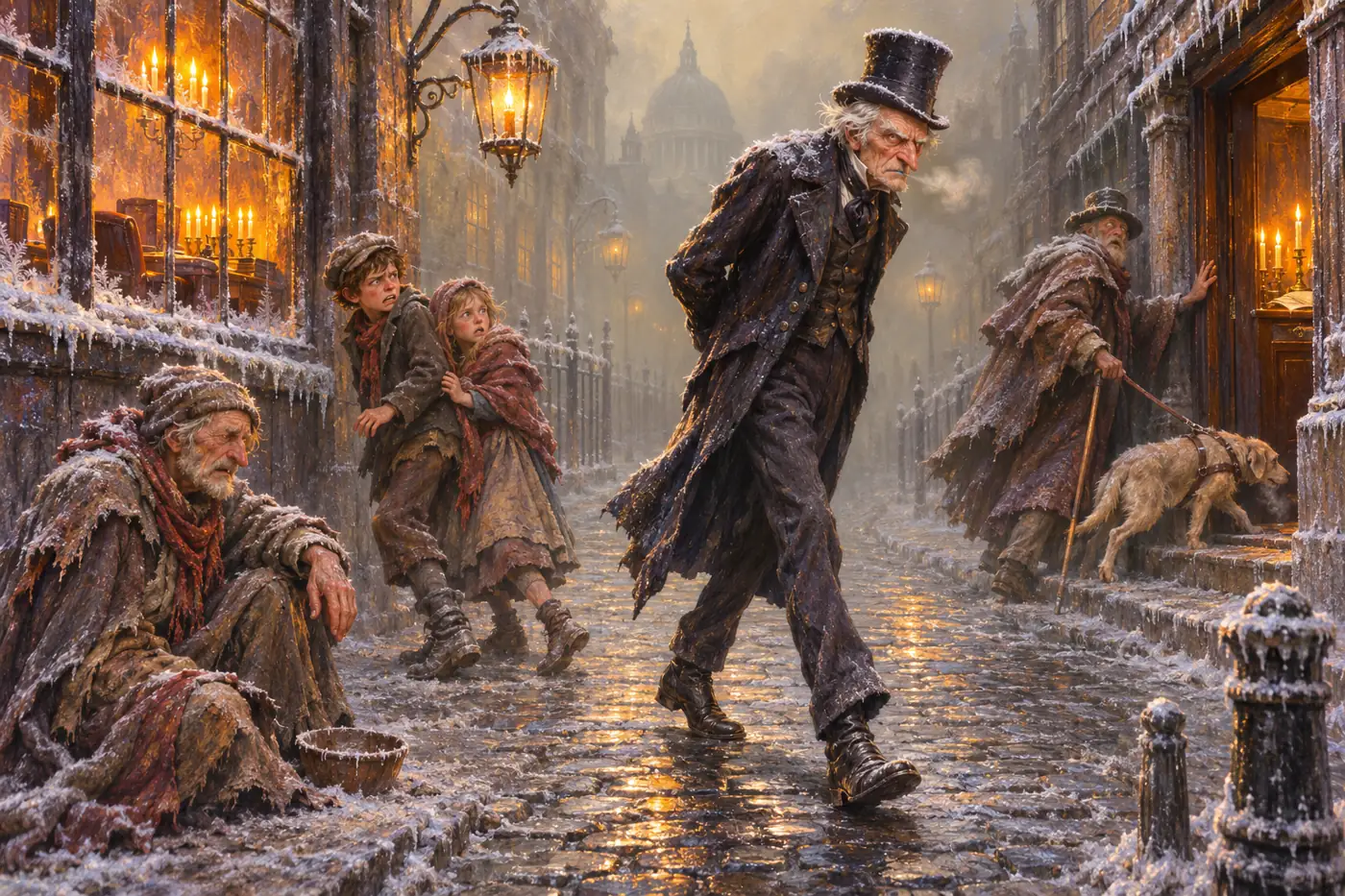
  1. Painted illustration: Scrooge in a black coat and top hat walks alone down a foggy London street on Christmas Eve while a beggar, two children and a blind man's dog keep out of his way.Stave OneFrozenMean, cold and alone by choice. He sees the poor as a problem to be got rid of.solitary as an oyster
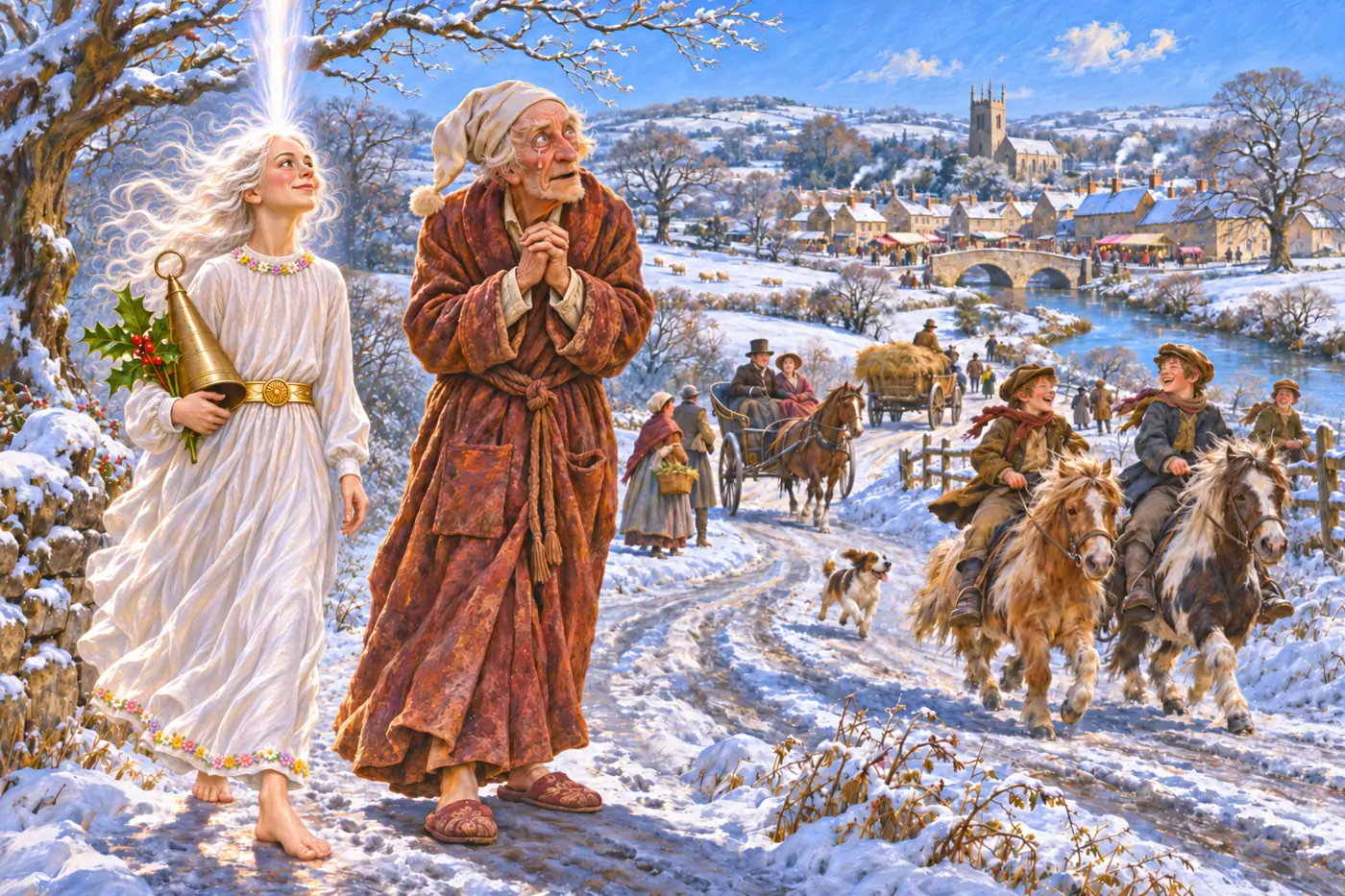
  2. Painted illustration: Scrooge in his dressing-gown and nightcap, hands clasped in wonder, walks beside the glowing Ghost of Christmas Past on a snowy country road, a little market town in the distance.Stave TwoRememberingMemories make him cry. He starts to feel sorry, for his younger self and for the carol singer he chased away.but it’s too late now
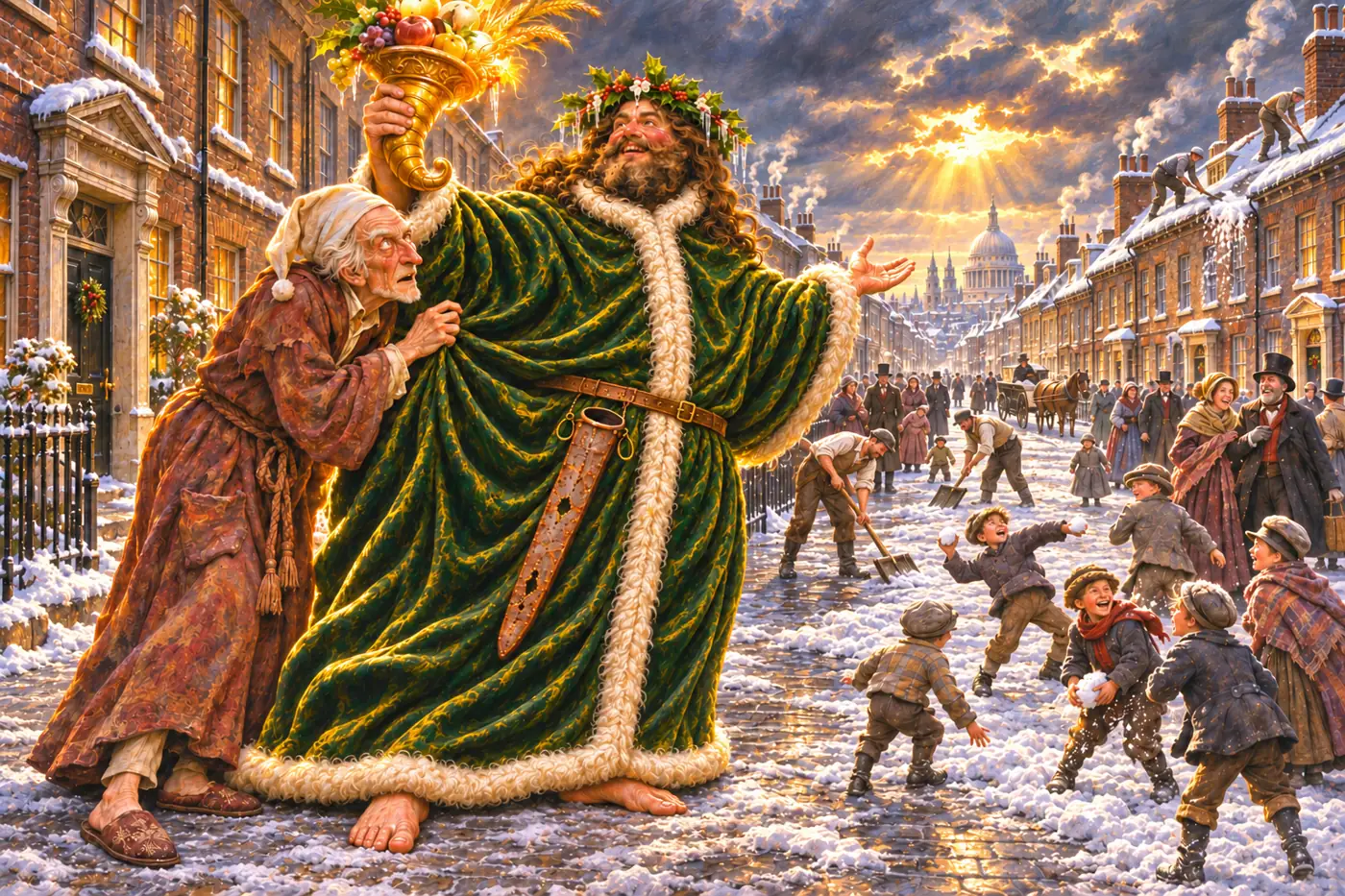
  3. Painted illustration: the giant Ghost of Christmas Present in a green fur-trimmed robe and holly crown stands with Scrooge in a snowy London street on Christmas morning, while people scrape snow from the pavements and shovel it off the roofs.Stave ThreeLearningHe feels pity for Tiny Tim and shame at his own cruel words.with an interest he had never felt before
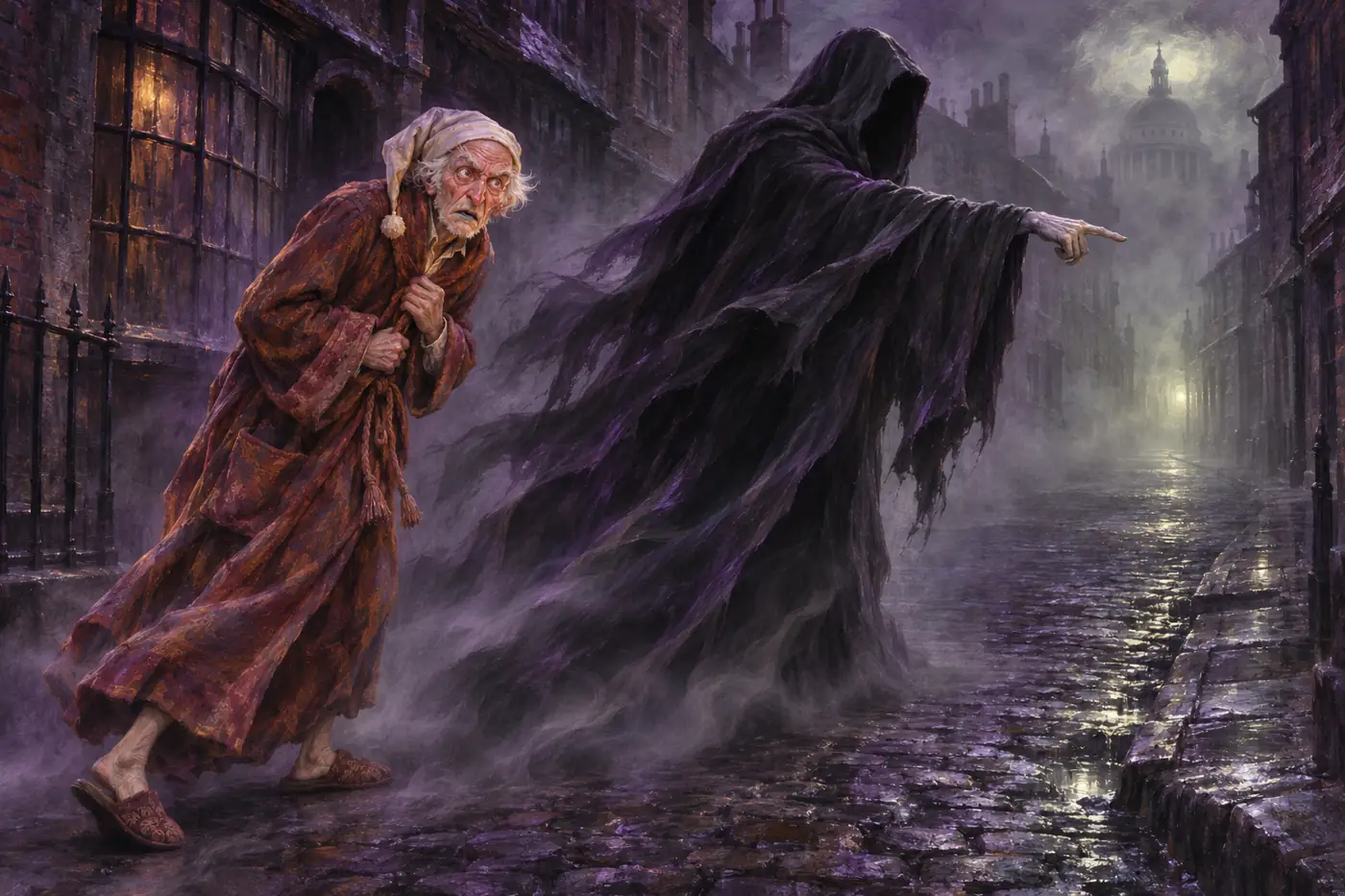
  4. Painted illustration: the black-hooded Ghost of Christmas Yet to Come glides through dark, foggy City streets, pointing ahead, as Scrooge in his nightcap follows in fear.Stave FourAfraidShown his own lonely death, he begs for the chance to change.I am not the man I was.
  5. Painted illustration: on a bright, frosty Christmas morning Scrooge, dressed in his best, walks down a snowy street beaming and patting a child on the head while passers-by smile.Stave FiveRebornJoyful and generous, he makes up for lost time.as good a friend, as good a master, and as good a man
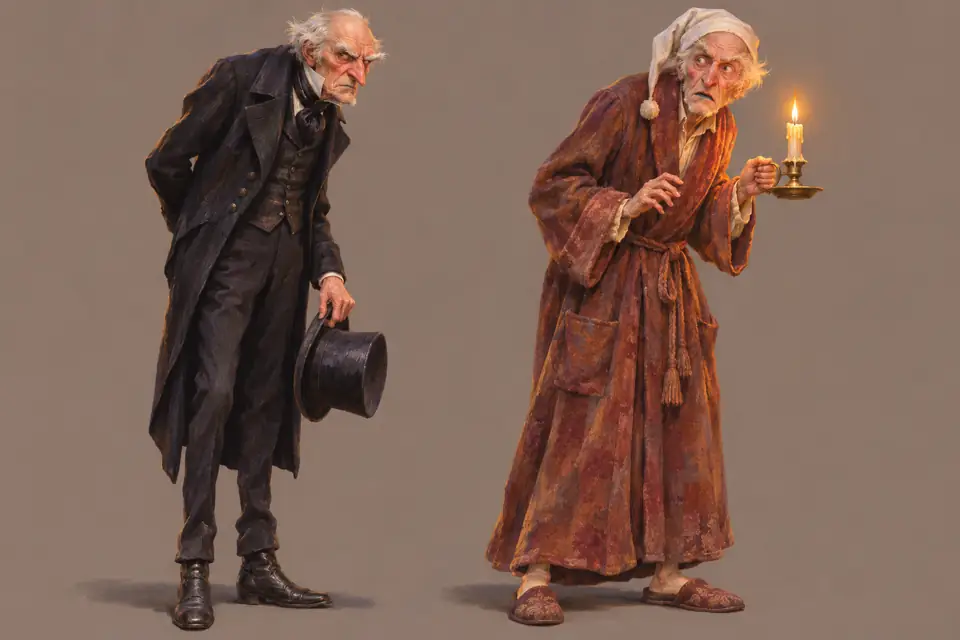
Painted character study: old Scrooge twice, once in his black business clothes with his top hat, scowling, and once in his dressing-gown, nightcap and slippers holding a candle.

Ebenezer Scrooge

A rich, mean old moneylender and the main character.

  • Dickens uses Scrooge to stand for rich people who ignore the poor. If even Scrooge can change, anyone can.
  • He is not simply evil. Stave Two shows a lonely boy and a young man who loved Belle, so his coldness was learned, and can be unlearned.
  • Stretch (grade 7+): his change is quick, almost comic. Dickens cares more about the message (anyone can change) than about realism.

Quotations to learn

  • Stave Onesolitary as an oysterShut away from everyone.
  • Stave FourI am not the man I was.The turning point.
  • Stave FiveI am as light as a featherThe weight of his chain has gone.
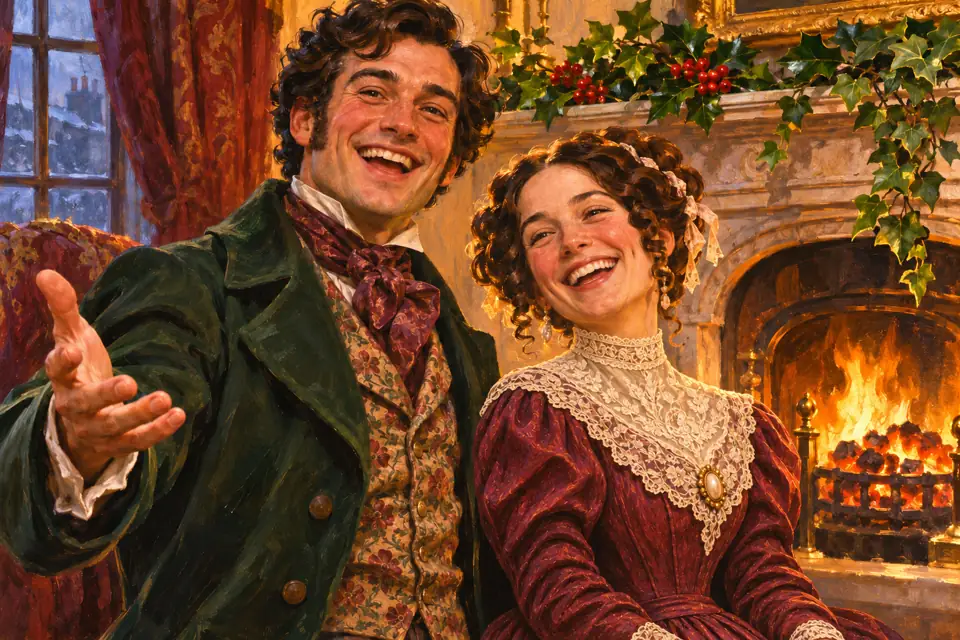
Painted portrait: Fred, a handsome, laughing young man in a green coat, with his laughing wife beside a fire hung with holly.

Fred

Scrooge’s nephew, the son of his dead sister Fan.

  • Fred is everything Scrooge is not: warm, cheerful, forgiving. He gives the novel’s best description of what Christmas should be.
  • He never gives up on his uncle. He invites him in Stave One and is still welcoming him in Stave Five.
  • Dickens uses Fred to show that family ties can survive anger, and that kindness is a choice.

Quotations to learn

  • Stave Onea kind, forgiving, charitable, pleasant timeHis definition of Christmas.
  • Stave ThreeI am sorry for him; I couldn’t be angry with him if I tried.He pities Scrooge rather than hating him.
  • Stave FiveWill you let me in, Fred?Scrooge finally accepts the invitation.
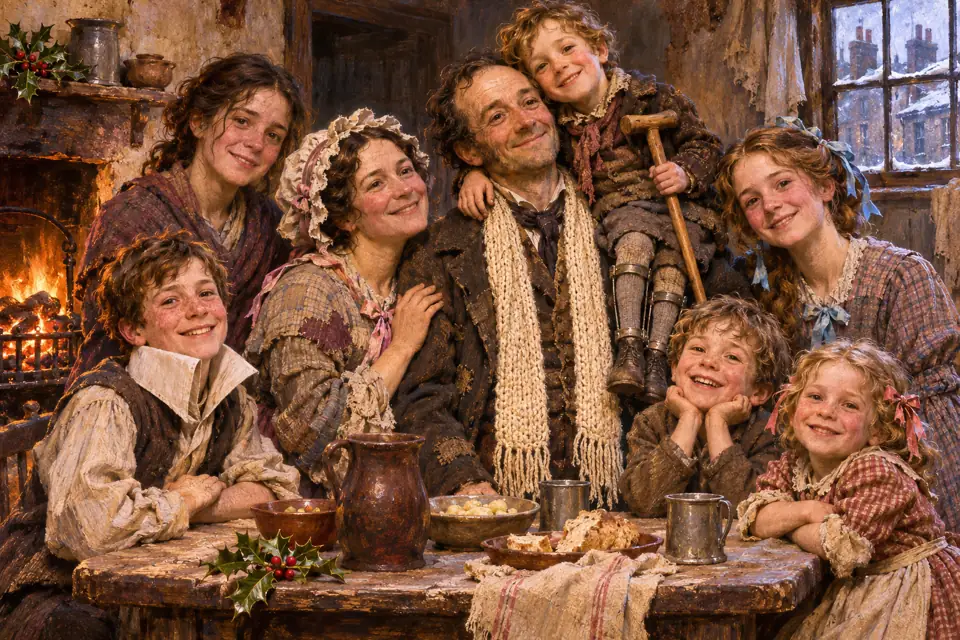
Painted group portrait: the poor but happy Cratchit family by their fire, with Bob in his long white comforter and Tiny Tim on his shoulder holding a little crutch.

Bob Cratchit and the Cratchits

Scrooge’s underpaid clerk and his large, loving family.

  • Bob is gentle, loyal and grateful, even to Scrooge. He has no greatcoat and only a tiny fire at work.
  • The family are poor but happy together. Dickens makes his readers love them, so that poverty has real faces.
  • Mrs Cratchit is more honest about Scrooge than Bob is: she calls him odious, stingy, hard, unfeeling.

Quotations to learn

  • Stave Onelooked like one coalBob’s tiny fire at work.
  • Stave Threehappy, grateful, pleased with one anotherPoor in money, rich in love.
  • Stave Threethe Founder of the FeastBob’s generous toast to his mean boss.
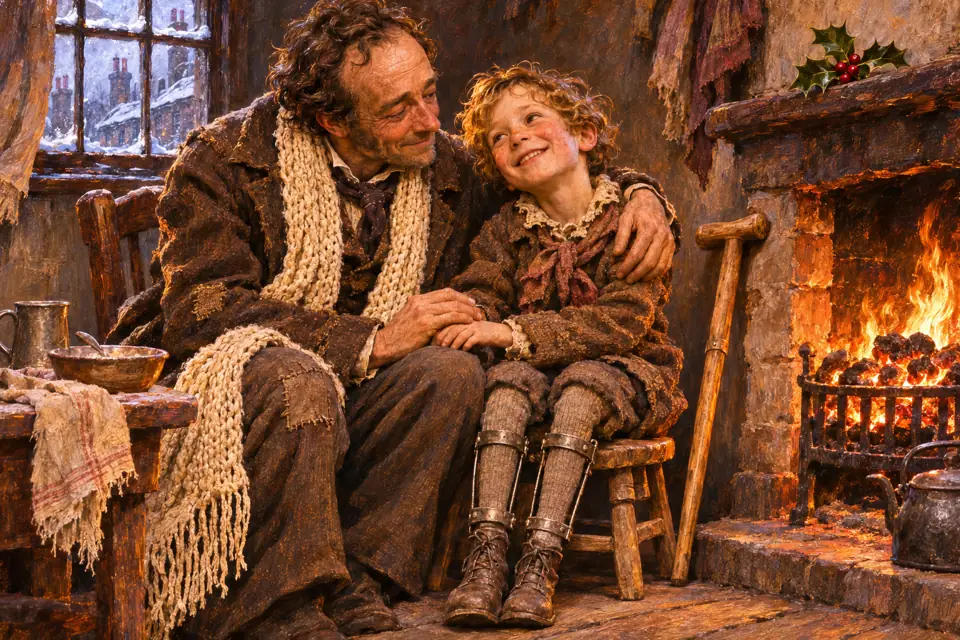
Painted portrait: small, pale Tiny Tim with curly hair sits on a stool by the fire, his crutch beside him, holding his father's hand.

Tiny Tim

Bob’s youngest son: small, disabled and seriously ill.

  • Tim is good, brave and kind. Dickens uses him to make readers feel the cost of poverty: a child who could be saved, but will die if nothing changes.
  • His life depends on Scrooge’s choices. That is why Scrooge’s request, tell me if Tiny Tim will live, matters so much.
  • Stretch (grade 7+): Tim works like a symbol of every poor child the reader could help.

Quotations to learn

  • Stave ThreeGod bless us every one!His blessing includes everyone.
  • Stave FourSpirit of Tiny Tim, thy childish essence was from God!His goodness is holy.
  • Stave Fivewho did NOT dieThe future changed.
Painted portrait: Marley's pale, see-through ghost with a bandaged jaw, dragging a long chain of cash-boxes, keys, padlocks and purses.

Jacob Marley

Scrooge’s business partner, dead for seven years.

  • Marley is a warning: he is what Scrooge will become. His chain shows that greed traps a person forever.
  • He sets up the plot by announcing the three Spirits.
  • He has learned his lesson too late, which is why his warning is so desperate.

Quotations to learn

  • Stave OneI wear the chain I forged in lifeHe made his own punishment.
  • Stave OneMankind was my business.What he should have cared about.
  • Stave Onedead as a door-nailThe comic, certain opening.
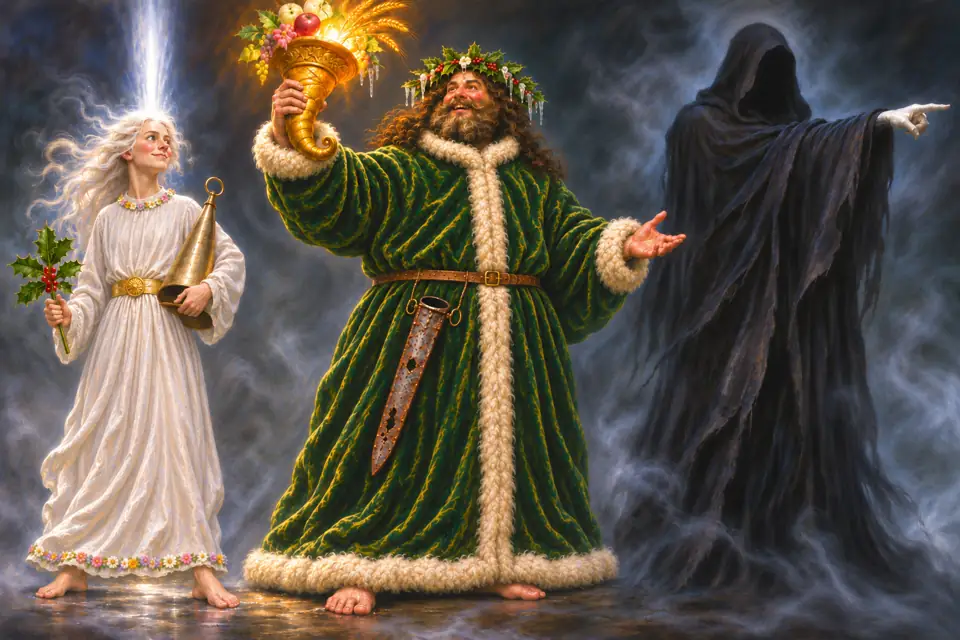
Painted group: the glowing Ghost of Christmas Past in a long white tunic with holly, the jolly giant Ghost of Christmas Present in a closed green robe with his torch, and the black-hooded Ghost of Christmas Yet to Come pointing.

The three Spirits

The Ghosts of Christmas Past, Present and Yet to Come.

  • Each Spirit teaches in a different way. The Ghost of Christmas Past uses memory, the Ghost of Christmas Present shows how others live, and the Ghost of Christmas Yet to Come uses fear.
  • They get darker and more frightening as the novel goes on, so the tension builds to the churchyard.
  • Each one looks like what it stands for: light for memory, plenty for generosity, a shroud for death.

Quotations to learn

  • Stave Twoa bright clear jet of lightThe Ghost of Christmas Past: memory and truth.
  • Stave Threea jolly Giant, glorious to seeThe Ghost of Christmas Present: generosity.
  • Stave Fourshrouded in a deep black garmentThe Ghost of Christmas Yet to Come: death.
Painted portrait: jolly old Fezziwig in a knitted woollen cap rubs his hands and laughs in his warehouse, with smiling Mrs Fezziwig beside him.

Old Fezziwig

The kind merchant Scrooge worked for as a young apprentice.

  • Fezziwig is the model boss. He spends a little money to make his workers very happy.
  • Dickens puts him there to contrast with Scrooge, who treats Bob so badly.
  • He shows that a businessman can be successful and kind at the same time.

Quotations to learn

  • Stave TwoNo more work to-night. Christmas Eve, Dick.He gives his workers Christmas.
  • Stave TwoThe happiness he gives, is quite as great as if it cost a fortune.Scrooge’s own praise.
Painted portrait: Belle, a fair young woman in a black mourning dress, sits by a window with tears in her eyes but a calm face.

Belle

The young woman Scrooge was going to marry.

  • Belle shows what Scrooge lost through greed: love and a family of his own.
  • She is calm and wise. She breaks the engagement for his sake as well as hers.
  • Her later happy family is the life Scrooge could have had.

Quotations to learn

  • Stave TwoAnother idol has displaced meMoney has replaced her.
  • Stave TwoA golden one.Her simple, final answer.
Painted illustration: two thin, scowling children in long rags kneel and cling to the hem of a giant's green fur-trimmed robe.

Ignorance and Want

Two starving children who cling to the Ghost of Christmas Present.

  • They are an allegory: they stand for ideas. Ignorance is the lack of education; Want is poverty and hunger.
  • The Spirit says they belong to all of society (They are Man’s), so everyone is responsible for them.
  • The boy, Ignorance, is the more dangerous: on his brow is written Doom, unless something is done.

Quotations to learn

  • Stave ThreeThis boy is Ignorance. This girl is Want.Naming the problems.
  • Stave ThreeYellow, meagre, ragged, scowling, wolfishNeglect has made them frightening to look at.
  • Stave Threemost of all beware this boyLack of education is the greatest danger.

4Themes

A theme is a big idea the whole novel explores. Each one below is traced through the staves, so you can always jump from the extract to the whole novel.

How Christmas is presented

Start here. This was the question you found hardest in your mock.

For Dickens, Christmas is a test of how we treat other people. To keep Christmas is to be kind, generous and part of a family or community, and to do it all year round.

The theme through the five staves

  1. Stave Oneevery idiot who goes about with ‘Merry Christmas’ on his lips, should be boiled with his own puddingScrooge’s hatred, shown through comic, violent exaggeration (hyperbole). He sees Christmas only as wasted money.
  2. Stave Onea kind, forgiving, charitable, pleasant timeFred’s list of adjectives is the novel’s own definition of Christmas: a time when people open their shut-up hearts freely.
  3. Stave Onea time, of all others, when Want is keenly felt, and Abundance rejoicesThe charity gentlemen show that Christmas makes the gap between rich and poor easier to see.
  4. Stave TwoA solitary child, neglected by his friends, is left there still.Christmas can also be painful for the lonely. The young Scrooge was left alone at Christmas.
  5. Stave TwoNo more work to-night. Christmas Eve, Dick.Fezziwig shows how an employer can share Christmas with his workers.
  6. Stave ThreeThere never was such a goose.The Cratchits make a feast out of very little. Christmas joy comes from love, not money.
  7. Stave ThreeGod bless us every one!Christmas is a Christian festival: Tiny Tim’s blessing is for everyone.
  8. Stave FourI will honour Christmas in my heart, and try to keep it all the year.Christmas becomes a promise about how to live every day.
  9. Stave Fivehe knew how to keep Christmas wellThe last judgement on Scrooge. Keeping Christmas means behaving well.

Dickens's methods AO2

  • Contrast: cold, fog and darkness in Stave One against warmth, light, food and fire in Staves Three and Five.
  • Lists of food and festive detail (the shops and the Spirit’s throne in Stave Three) make Christmas feel rich and joyful.
  • Structure: the novel is a ‘carol’ in five ‘staves’ (verses of a song), and it moves from Christmas Eve through Christmas Day to the next morning and the rest of Scrooge’s life.
  • Religious language: blessings, church bells and Tiny Tim’s words about who made lame beggars walk, and blind men see.

Context AO3

Interest in older Christmas customs was already growing when Dickens wrote. The Carol did not invent Christmas, but it helped make it a time for family, feasting and generosity to the poor.

Stretch (grade 7+)

Dickens’s Christmas is more about how people treat each other than about church. Christmas is a test for the rich: what will they do for the poor?

Exam tip

If the question is about Christmas, follow it through all five staves: Scrooge’s hatred, painful and happy memories, celebration everywhere, a future without Christmas joy, and Scrooge’s Christmas Day, then lasting kindness after Christmas.

Poverty and social responsibility

Dickens argues that the poor are not a problem to be ignored: the rich have a duty to help them, and society will suffer if they do not.

The theme through the five staves

  1. Stave OneAre there no prisons?Scrooge thinks the poor are the state’s problem, not his.
  2. Stave Onedecrease the surplus populationCold, official language that treats poor people as a number.
  3. Stave OneMankind was my business.Marley learns too late that caring for others was his real duty.
  4. Stave Threefifteen “Bob” a-weekBob’s modest wage has to feed a family of eight.
  5. Stave ThreeIf he be like to die, he had better do itScrooge’s words, quoted back about a real child, show how cruel they were.
  6. Stave ThreeThis boy is Ignorance. This girl is Want.Poverty and lack of education are society’s children: everyone’s responsibility.
  7. Stave FourThe ways were foul and narrow; the shops and houses wretchedThe slum where old Joe lives shows how poverty drives people to crime.
  8. Stave FiveA great many back-payments are included in itThe changed Scrooge gives generously and puts right his past.

Dickens's methods AO2

  • Allegory: Ignorance and Want stand for big social problems.
  • Structure: Scrooge’s words from Stave One are repeated by the Spirit in Stave Three.
  • Contrast: Scrooge’s wealth against the Cratchits’ poverty; the rich City against old Joe’s slum.

Context AO3

The Poor Law of 1834 was meant to make the harsh workhouse the main help for poor people who could work. Dickens wanted his readers to feel responsible for the poor themselves.

Stretch (grade 7+)

Dickens does not ask for revolution. He asks the rich to change their hearts, one person at a time, as Scrooge does.

Exam tip

Link the extract to Scrooge’s Are there no prisons? in Stave One and to Ignorance and Want in Stave Three: examiners like answers that track words that come back.

Redemption and transformation

Anyone can change, however bad they have been, if they face the truth about themselves. It is never too late while you are alive.

The theme through the five staves

  1. Stave OneI wear the chain I forged in lifeMarley shows what happens if you do not change.
  2. Stave OneA chance and hope of my procuringMarley gives Scrooge a second chance.
  3. Stave Twobut it’s too late nowScrooge feels his first regret, about the carol singer.
  4. Stave Threewith an interest he had never felt beforeHe starts to care about Tiny Tim.
  5. Stave FourMen’s courses will foreshadow certain endsOur future depends on our choices.
  6. Stave FourI am not the man I was.He declares his change at his own grave.
  7. Stave FiveI am as light as a featherFree from his chain, he feels light.
  8. Stave Fiveas good a friend, as good a master, and as good a manThe change is complete, and lasts.

Dickens's methods AO2

  • Cyclical structure: the novel begins and ends with Scrooge’s reputation; he wakes in the same bed, but a new man.
  • Pathetic fallacy: fog and frost in Stave One, golden sunlight in Stave Five.
  • Repetition and echo: the bedpost, the bed-curtains and his own words come back changed.

Context AO3

Victorian Christians believed that sinners who truly repented could be saved. Dickens gives that idea a social side: repenting means helping others.

Stretch (grade 7+)

Some readers find the change too sudden. You could argue Dickens builds it carefully: each Spirit softens Scrooge a little, so Stave Five feels earned.

Exam tip

Use the five stages of Scrooge’s change (in the Characters section) as a ready-made paragraph plan for any question about Scrooge.

Family and togetherness

Family and friendship bring the real happiness that money cannot buy. Scrooge’s loneliness is his punishment; joining a family is his reward.

The theme through the five staves

  1. Stave OneCome! Dine with us to-morrow.Fred keeps offering Scrooge a place in the family.
  2. Stave TwoFather is so much kinder than he used to be, that home’s like Heaven!Fan brings young Scrooge home: family can heal.
  3. Stave Twomight have called him fatherSeeing Belle’s daughter, Scrooge realises what family he has missed.
  4. Stave Threehappy, grateful, pleased with one anotherThe Cratchits are poor but rich in love.
  5. Stave FourMy little, little child!Bob’s grief shows how much the family loves Tim.
  6. Stave Fivehe was a second fatherScrooge joins the Cratchit family as Tim’s protector.

Dickens's methods AO2

  • Contrast: Scrooge’s cold, empty rooms against the crowded, warm homes of the Cratchits, Fred and Belle.
  • Dialogue: family scenes are full of lively talk and laughter; Scrooge’s early speech is short and sharp.

Context AO3

Victorian readers valued the home and family very highly. Dickens shows family joy as something the poor can have, even when money is short.

Stretch (grade 7+)

Family in the novel is wider than blood: Fezziwig’s workplace and Scrooge’s second father role show families that people choose.

Exam tip

Family works well with almost any Christmas question: the Cratchits’ dinner and Fred’s party are both family Christmases.

5Context AO3

Context is worth 6 of the 30 marks. These facts were checked against reliable sources. Each one says where it shows in the novel, because context only earns marks when it helps answer the question.

Dickens's own life

  • Charles Dickens was born in 1812 in Portsmouth and died in 1870. He was the most popular novelist of his day.
  • When he was 12, his father was imprisoned for debt in the Marshalsea prison. Charles was sent to work in a blacking warehouse, covering and labelling pots of boot polish.In the novel: This may help explain his sympathy for poor children like Tiny Tim, and for the lonely boy Scrooge in Stave Two.
  • As a boy he lived for a time in Camden Town, the area where the Cratchits live.In the novel: Bob runs home to Camden Town as hard as he could pelt.

1843: why he wrote it

  • Early in 1843 Dickens read a government report on children working in mines and factories. He planned a pamphlet, ‘An Appeal to the People of England, on behalf of the Poor Man’s Child’, then decided a story would hit much harder.In the novel: This is why the novel is so direct about poverty.
  • In September 1843 he visited a Ragged School in London: a free school for very poor children. He called it ‘an awful sight’.In the novel: Ignorance, the boy in Stave Three, is the danger Dickens saw there: children left without education or care.
  • He wrote the book in about six weeks in October and November 1843, and later said he ‘wept and laughed and wept again’ while writing it. It came out on 19 December 1843, paid for by Dickens himself, at five shillings. The first 6,000 copies sold out by Christmas Eve.
  • The novelist William Makepeace Thackeray called it ‘a national benefit’.

The poor in the 1840s

  • The Poor Law Amendment Act of 1834 was meant to make the workhouse the main help for poor people who could work. Workhouses were made harsh on purpose, and families were split up inside them.In the novel: Scrooge asks And the Union workhouses? and says I help to support the establishments I have mentioned.
  • Thomas Malthus, an economist, argued in 1798 that, unless something held it back, population would grow faster than the food supply. Some people used this to argue against helping the poor.In the novel: Scrooge’s surplus population echoes this way of thinking.
  • Prisoners could be made to walk on a treadmill, a huge turning wheel, as hard labour.In the novel: Scrooge asks if The Treadmill and the Poor Law are in full vigour.
  • People who could not pay their debts could be sent to prison.In the novel: The young couple in Stave Four are relieved that the man they owed money to is dead.
  • In the 1840s about 15 in every 100 babies in England and Wales died before their first birthday.In the novel: Illness was a real danger for poor families like the Cratchits, as Tiny Tim shows.
  • The early 1840s, later called the ‘Hungry Forties’, were a time of hunger and unemployment for many working people.

Christmas in the 1840s

  • Interest in older Christmas customs was already growing when Dickens wrote. The Carol did not invent Christmas, but it helped make it a time for family, feasting and generosity.
  • The first Christmas cards were sold in 1843. Christmas trees became popular in Britain after a picture of Queen Victoria’s family tree was printed in 1848, so there are none in the novel.
  • Christmas is a Christian festival celebrating the birth of Jesus. Dickens’s readers would hear the Christian message in Tiny Tim’s words and Scrooge’s change of heart.In the novel: God bless us every one!
  • Dickens called his chapters ‘staves’, the verses of a song, to match the title: it is a carol.
Use context to answer the question. Never add a history paragraph at the end. Instead, link one fact to one moment: ‘Scrooge’s “surplus population” echoes Malthus, so Dickens attacks a real attitude of his time.’

6Model answer

In June 2025 AQA printed the Cratchits’ Christmas from Stave Three and asked about the importance of kindness. It is the latest question in this guide, and its extract is a Christmas scene, so it is good practice for your mock question about Christmas.

The task · June 2025 · 30 marks

In this extract, the Ghost of Christmas Present shows Scrooge the Cratchit family at Christmas.

Starting with this extract, explore how Dickens presents the importance of kindness in A Christmas Carol.

  • how Dickens presents kindness in this extract
  • how Dickens presents the importance of kindness in the novel as a whole.
Read the extract AQA printed (442 words)

At last the dinner was all done, the cloth was cleared, the hearth swept, and the fire made up. The compound in the jug being tasted, and considered perfect, apples and oranges were put upon the table, and a shovel-full of chestnuts on the fire. Then all the Cratchit family drew round the hearth, in what Bob Cratchit called a circle, meaning half a one; and at Bob Cratchit’s elbow stood the family display of glass. Two tumblers, and a custard-cup without a handle.

These held the hot stuff from the jug, however, as well as golden goblets would have done; and Bob served it out with beaming looks, while the chestnuts on the fire sputtered and cracked noisily. Then Bob proposed:

“A Merry Christmas to us all, my dears. God bless us!”

Which all the family re-echoed.

“God bless us every one!” said Tiny Tim, the last of all.

He sat very close to his father’s side upon his little stool. Bob held his withered little hand in his, as if he loved the child, and wished to keep him by his side, and dreaded that he might be taken from him.

“Spirit,” said Scrooge, with an interest he had never felt before, “tell me if Tiny Tim will live.”

“I see a vacant seat,” replied the Ghost, “in the poor chimney-corner, and a crutch without an owner, carefully preserved. If these shadows remain unaltered by the Future, the child will die.”

“No, no,” said Scrooge. “Oh, no, kind Spirit! say he will be spared.”

“If these shadows remain unaltered by the Future, none other of my race,” returned the Ghost, “will find him here. What then? If he be like to die, he had better do it, and decrease the surplus population.”

Scrooge hung his head to hear his own words quoted by the Spirit, and was overcome with penitence and grief.

“Man,” said the Ghost, “if man you be in heart, not adamant, forbear that wicked cant until you have discovered What the surplus is, and Where it is. Will you decide what men shall live, what men shall die? It may be, that in the sight of Heaven, you are more worthless and less fit to live than millions like this poor man’s child. Oh God! to hear the Insect on the leaf pronouncing on the too much life among his hungry brothers in the dust!”

Scrooge bent before the Ghost’s rebuke, and trembling cast his eyes upon the ground. But he raised them speedily, on hearing his own name.

“Mr. Scrooge!” said Bob; “I’ll give you Mr. Scrooge, the Founder of the Feast!”

What the examiners suggested

  • The Cratchits as an example of family love and kindness; Tiny Tim showing kindness and compassion to everyone.
  • The Ghost of Christmas Present as the spirit of Christmas and generosity; other kind characters such as Fezziwig; Scrooge’s change from cold to kind.
  • Methods: the fire as a symbol of warmth and kindness; the repeated ‘God bless us’; the emotive picture of Tiny Tim; the echo of ‘surplus population’; the metaphor of the insect on the leaf.
  • Context: Christian values and the meaning of Christmas; family; society and class; Dickens’s message about what matters in life.

From AQA's mark scheme, June 2025 (indicative content).

Plan in 5 minutes

  1. Kindness at home: the Cratchits share very little, generously (the fire, the cups, Tiny Tim’s blessing).
  2. Kindness missing: the Ghost turns Scrooge’s cruel words back on him.
  3. Kindness costs little: Fezziwig in Stave Two, Bob’s toast in the extract.
  4. Kindness changes lives: Scrooge in Stave Five, and Tiny Tim, who lives.

Model answer

Opening

Dickens presents kindness as the most important value in the novel: it holds families together, it costs the giver far less than it gives, and when it becomes real help it can save lives. In this extract the Cratchits have very little money, yet their kindness to each other makes their Christmas rich, while the Ghost of Christmas Present shows Scrooge how cruel his own lack of kindness has been. Across the novel Dickens shows that kindness is a choice open to everyone, even Scrooge.

Extract: kindness at home

In the extract, Dickens makes the Cratchits’ kindness visible in small, warm details. The family drew round the hearth, and the fire becomes a symbol of the warmth they give each other. Their Two tumblers, and a custard-cup without a handle is a comic list of how little they own, but Dickens insists these held the drink as well as golden goblets would have done. The contrast between mismatched cups and golden goblets suggests that love, not wealth, makes a celebration. Tiny Tim adds every one to Bob’s God bless us!, so his blessing includes everyone. For Dickens’s Christian readers this captures the meaning of Christmas: blessing others, not ourselves.

Extract: kindness missing

Dickens also shows how much kindness matters by exposing its opposite. When Scrooge begs to know if Tim will live, the Ghost repeats Scrooge’s own words from Stave One: If he be like to die, he had better do it, and decrease the surplus population. The cold, official phrase that Scrooge used about strangers now lands on a child he has come to care for, and he is overcome with penitence and grief. The Ghost’s metaphor of the Insect on the leaf shrinks Scrooge: a rich man judging the poor is like an insect judging his hungry brothers in the dust. By calling the poor Scrooge’s brothers, Dickens attacks the Malthusian idea that the poor are a surplus, and reminds his comfortable readers that the poor are their family too.

Whole novel: kindness costs little

Kindness matters in the novel because it is cheap to give and priceless to receive. In Stave Two, Scrooge defends his old employer Fezziwig, who spent only a few pounds on a party: The happiness he gives, is quite as great as if it cost a fortune. Without meaning to, Scrooge judges himself, and at once he thinks of his own clerk. The extract shows the same idea from the other side: Bob toasts his mean employer as the Founder of the Feast, even though Scrooge pays him so little. Bob’s kindness shows that kindness is a choice, not a reward.

Whole novel: kindness changes lives

Finally, Dickens shows that kindness can change lives, including the giver’s. In Stave Five Scrooge’s first act is to send the prize turkey to the Cratchits, laughing that It’s twice the size of Tiny Tim. He gives to the charity collector with A great many back-payments and raises Bob’s salary. The capital letters in who did NOT die show that Scrooge’s kindness has changed the future the Ghost foresaw in the extract’s vacant seat. Words are not enough here: Tim lives because Scrooge’s kindness becomes money and care, as Scrooge pays Bob fairly and becomes a second father to Tim. The novel’s structure, moving from The cold within him in Stave One to joy in Stave Five, makes kindness the cure for Scrooge’s coldness. In the 1840s, when the Poor Law left many poor families facing the workhouse, this was Dickens’s message to the rich: kindness, including fair pay, can save lives.

Conclusion

Dickens presents kindness as the heart of Christmas and of a good life. The Cratchits show it at home, the Ghost shows what happens without it, and Scrooge proves that anyone can learn it. The novel ends by turning Tiny Tim’s blessing to the reader, God bless Us, Every One!, so the lesson of kindness is passed on to us.

Why this scores highly: it answers the question in its first sentence, starts with the extract and then moves to Staves One, Two and Five, analyses short quotations closely, and uses context (Christian values, Malthus, the Poor Law) to explain Dickens’s message rather than as a history lesson.

7How to write your answer

5minutes: plan

Read the extract and underline 3 or 4 quotations. Then jot down 2 or 3 moments from other staves that fit the question.

40minutes: write

Open with a big idea that answers the question. Then 3 or 4 paragraphs that move from the extract to the rest of the novel.

5minutes: check

Have you covered both bullets? Named techniques and explained their effects? Used context to answer the question?

Paper 1 lasts 1 hour 45 minutes. Both sections are worth 30 marks (Section A has 4 extra marks for spelling and grammar). AQA does not split the time, but its 2025 examiner report tells students to ‘spend their time equally on both sections’. When this question had its own paper in 2021 and 2022, AQA allowed 50 minutes.

Paragraph frame

WhatDickens presents [the idea in the question] as ...

HowIn the extract, the [technique] "quotation" suggests ... The word "..." shows ...

HowThis idea returns in Stave [number], when "quotation" ...

WhyDickens wants his readers to feel / realise ...

ContextThis links to [context], because ...

Bridges from the extract to the whole novel

EarlierEarlier, in Stave One,This was set up whenAt the start of the novel
LaterLater, in Stave Five,This idea returns whenBy the end of the novel

The levels, in plain words

Level 1 · 1 to 5Simple comments. Mostly retells the story.
Level 2 · 6 to 10Supported, relevant comments. Spots some of the writer's choices and uses some terms.
Level 3 · 11 to 15Explained comments. Explains the effects of some methods, with some context.
Level 4 · 16 to 20Clear understanding. Clear explanation of effects, well-chosen references, clear links to context.
Level 5 · 21 to 25Thoughtful and developed. Quotations woven into the argument; examines methods and context in detail.
Level 6 · 26 to 30Convincing, critical and exploratory. Precise references and fine-grained analysis.

Summarised from AQA’s 8702/1 mark scheme, June 2025. The same levels have been used in every series since 2017.

8Key terms

Use the right word, then explain the effect. A named technique with no effect earns very little.

NovellaA short novel. A Christmas Carol is a novella.e.g. five staves, short enough to read in an evening
StaveA verse of a song. Dickens’s name for his five chapters, to match the title ‘carol’. AQA’s papers call them chapters.e.g. Stave One: Marley’s Ghost
AllegoryA story or character that stands for a bigger idea.e.g. This boy is Ignorance. This girl is Want.
NarratorThe voice telling the story. Dickens’s narrator chats to us and gives opinions.e.g. Mind! I don’t mean to say that I know, of my own knowledge, what there is particularly dead about a door-nail.
SimileA comparison using like or as.e.g. solitary as an oyster
MetaphorDescribing something as if it were something else.e.g. I wear the chain I forged in life
PersonificationGiving human qualities to something that is not human.e.g. the church bell, always peeping slily down at Scrooge like a nosy neighbour
Pathetic fallacyWeather or setting that reflects a character’s feelings.e.g. fog and frost around cold Scrooge; Golden sunlight when he changes
Semantic fieldA group of words on the same topic.e.g. cold words around Scrooge: The cold within him froze his old features
SymbolAn object that stands for an idea.e.g. the Ghost of Christmas Past’s bright clear jet of light (truth and memory)
ForeshadowingA hint of what will happen later.e.g. a crutch without an owner, carefully preserved
ContrastPutting opposites side by side to make both stand out.e.g. Scrooge’s tiny fire against Fezziwig’s fire heaped up for the party
IronyWhen words mean the opposite of what they seem, or events turn against a character.e.g. Bob calls Scrooge the Founder of the Feast
HyperboleDeliberate exaggeration.e.g. should be boiled with his own pudding, and buried with a stake of holly through his heart
Rhetorical questionA question asked for effect, not for an answer.e.g. Are there no prisons?
Cyclical structureA story that ends where it began, but changed.e.g. Christmas Eve in the counting-house, then the counting-house again in Stave Five
DidacticWritten to teach a moral lesson.e.g. Dickens’s message: Mankind was my business.

9Test yourself

Say your answer out loud first, then tap to check.

Round 1: Which stave?

Scrooge sees Marley’s face in his door-knocker.

Stave One · Marley’s Ghost

Scrooge watches a lonely boy reading in an empty schoolroom.

Stave Two · The First of the Three Spirits

Two charity collectors leave with nothing.

Stave One · Marley’s Ghost

A giant sits on a throne made of food.

Stave Three · The Second of the Three Spirits

Belle sets Scrooge free from their engagement.

Stave Two · The First of the Three Spirits

Old Joe buys a dead man’s bed-curtains.

Stave Four · The Last of the Spirits

Scrooge sends a turkey to Camden Town.

Stave Five · The End of It

Two children called Ignorance and Want appear.

Stave Three · The Second of the Three Spirits

Scrooge reads his own name on a gravestone.

Stave Four · The Last of the Spirits

Scrooge raises Bob’s salary.

Stave Five · The End of It

Round 2: Finish the quotation

solitary as an _____ (Stave One)

oyster

Hard and sharp as _____ (Stave One)

flint

I wear the _____ I forged in life (Stave One)

chain

Mankind was my _____. (Stave One)

business

Another _____ has displaced me (Stave Two)

idol

a bright clear jet of _____ (Stave Two)

light

This boy is Ignorance. This girl is _____. (Stave Three)

Want

a jolly _____, glorious to see (Stave Three)

Giant

_____ in a deep black garment (Stave Four)

shrouded

I will honour Christmas in my _____, and try to keep it all the year. (Stave Four)

heart

I am as light as a _____ (Stave Five)

feather

he knew how to keep Christmas _____ (Stave Five)

well

Round 3: Name the technique

squeezing, wrenching, grasping, scraping, clutching, covetous, old sinner! (Stave One)
Clue: many words in a row, all about grabbing

A list

solitary as an oyster (Stave One)
Clue: look for the word as

Simile

Are there no prisons? (Stave One)
Clue: does Scrooge want an answer?

Rhetorical question

Another idol has displaced me (Stave Two)
Clue: an idol is a false god

Religious metaphor: money is his god

This boy is Ignorance. This girl is Want. (Stave Three)
Clue: the children stand for ideas

Allegory

fifteen “Bob” a-week (Stave Three)
Clue: bob was slang for a shilling

Pun (a play on Bob’s name)

plundered and bereft, unwatched, unwept, uncared for (Stave Four)
Clue: look at how three of the words begin

Repeated prefix ‘un-’

Golden sunlight; Heavenly sky; sweet fresh air; merry bells. (Stave Five)
Clue: the weather matches his mood

Pathetic fallacy

Round 4: Context in the novel

The 1834 Poor Law was meant to make the workhouse the main help for poor people. Which two places does Scrooge name when he is asked to help the poor?

Prisons and workhouses: Are there no prisons? and And the Union workhouses? (Stave One)

Thomas Malthus argued that, unless something held it back, population would grow faster than the food supply. Which two words of Scrooge’s echo this idea?

surplus population (Stave One)

In 1843 Dickens visited a Ragged School for very poor children. Which of the two children under the Spirit’s robe does the Spirit say to fear most?

The boy, Ignorance (Stave Three)

Dickens’s father was imprisoned for debt. In Stave Four, who is relieved to hear that a man has died?

A young couple who owed him money

As a boy, Dickens lived in Camden Town. Which family in the novel lives there?

The Cratchits: Bob runs home to Camden Town

Christmas is a Christian festival. What blessing does Tiny Tim give after Bob’s toast?

God bless us every one! (Stave Three)

Prisoners in the 1840s could be put on the treadmill. Which two things does Scrooge hope are still in full vigour?

The Treadmill and the Poor Law (Stave One)

In the 1840s, interest in Christmas as a time of family, feasting and charity was already growing. Who calls Christmas a kind, forgiving, charitable, pleasant time?

Fred, Scrooge’s nephew (Stave One)